




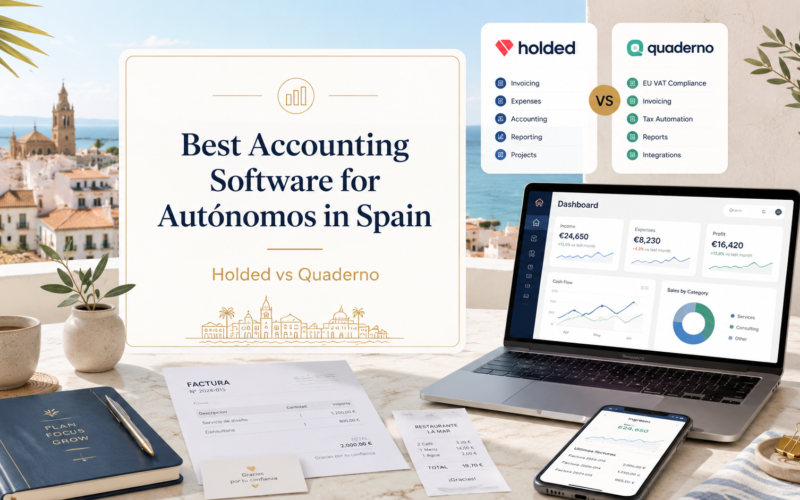
Best Accounting Software for Autónomos in Spain: Holded vs Quaderno (2026)
Choosing the best accounting software for autónomos in Spain is no longer just about saving time. It is about issuing compliant facturas, tracking IVA correctly, preparing quarterly Modelo 303 and Modelo 130 reports, and getting ready for stricter Spanish invoicing rules such as Verifactu.
I have been running digital businesses from Málaga for several years, and I would not manage autónomo invoicing manually. A spreadsheet works until the first quarter with mixed currencies, affiliate income, Spanish clients, EU reverse charge, deductible expenses and a gestoría asking for clean reports. Good software turns that mess into a 20-minute quarterly workflow. If you have not yet registered as autónomo, read our complete autónomo registration guide first.
This guide compares the main options with honest assessments of what each actually does well and where it falls short – including which platforms are preparing for Spain’s new Verifactu invoicing requirements.
Last updated: June 2026. Software pricing, features and plan structures change regularly. Always verify current pricing directly with the provider before subscribing. Pricing shown here is approximate – treat it as a reference range only.
⚡ Our top picks – accounting software for Spanish autónomos
- Best overall: Holded – full business management, Spanish IVA built in, English interface, from ~€19/month. Best for most autónomos.
- Best for VAT compliance and international sales: Quaderno – strongest multi-jurisdiction VAT compliance, Stripe/PayPal integration and automatic tax reports. Best for international clients, digital products, subscriptions and EU VAT/OSS complexity. Check current pricing at quaderno.io.
- Best budget option: Anfix or Contasimple – lower cost, Spanish-language, good for simple Spain-only businesses.
- Best for English-first freelancers: FreshBooks – familiar to international freelancers, decent IVA support, multi-currency.
Which software should I choose? – Quick decision
Spain-based autónomo, Spanish clients, need full accountingHolded
International clients, Stripe/PayPal, EU VAT or OSSQuaderno (or both)
Simple Spain-only billing, tight budgetAnfix or Contasimple
English-first, familiar international platformFreshBooks
Preparing for Verifactu/SIF requirements (2027)Ask Holded or your gestoría
📋 Quick navigation
Why autónomos in Spain need accounting software
Spanish tax law does not treat invoice errors lightly. A factura that is missing a required field – the client’s NIF, the correct invoice number, or the applicable IVA rate – is not a valid factura under Hacienda rules. Errors or omissions in IVA declarations can result in fines and surcharges that compound quickly. The exact penalties depend on the nature of the infringement, the amounts involved and whether it is an isolated or repeated error – always consult your gestoría if you suspect a compliance issue.
The quarterly calendar alone justifies the software cost. As an autónomo you file:
- Modelo 303 (quarterly IVA declaration) – April, July, October, and 1-30 January for Q4
- Modelo 130 (quarterly IRPF payment on account) – same schedule
- Modelo 390 (annual IVA summary) – January
- Modelo 100 (annual IRPF return) – April-June
Without software, preparing the Modelo 303 means manually adding up every invoice you issued, separating by IVA rate, then subtracting IVA paid on deductible expenses. With Holded or Quaderno, that summary is generated automatically. Your gestoría gets a clean report. You spend 15 minutes, not 3 hours.
⚠️ What a compliant Spanish factura must include
- Sequential invoice number with correlative numbering within each series (Hacienda requires that invoices in a series are numbered consecutively – skipping or reusing numbers creates compliance issues)
- Invoice date
- Your full name or company name, and your NIE or NIF
- Your fiscal address
- Client’s full name and NIF/VAT number (for business clients)
- Description of the service or product
- Net amount (base imponible)
- IVA rate applied (21%, 10%, 4% or 0%) and the IVA amount in euros
- Total invoice amount including IVA
- IRPF retention if applicable (as a deduction on the invoice total)
Good accounting software generates all of this automatically. You enter the client, the amount, and the service description. The software handles the rest. If you try to manage this manually with a Word template, you will eventually issue an invoice with the wrong number, forget to include a required field, or miscalculate an IVA amount – all of which create problems at declaration time.
Frank’s experience – why I use software
I run three websites with different revenue streams – some invoiced in euros to Spanish clients, some in foreign currencies to international clients, some through affiliate platforms. Tracking IVA manually across all of that is not something I would attempt. The software cost is a deductible business expense. The time saving is real and immediate. The avoided errors are worth more than the subscription fee in the first quarter.
Verifactu and electronic invoicing: what autónomos need to know for 2026-2027
Verifactu (Sistema de Información de Facturación / SIF) is Spain’s new framework requiring invoicing software to meet specific technical and security standards set by Hacienda. It is not a new tax – it is a new requirement for how invoicing software must work and report to the Agencia Tributaria.
The deadlines that affect autónomos most directly:
- Companies and large taxpayers: invoicing systems must be adapted before 1 January 2027
- Other taxpayers including many autónomos: before 1 July 2027
These deadlines have already been extended once from earlier dates, and Hacienda has published official guidance at sede.agenciatributaria.gob.es. The July 2027 deadline gives most autónomos time to act, but 2026 is the right moment to make the switch from manual or unverified systems to software that is actively preparing for Verifactu compliance.
⚠️ What Verifactu means for your invoice software choice
- Manual Word or Excel invoices will likely not comply with Verifactu/SIF requirements from 2027
- Software platforms that are Verifactu-ready will generate invoices with the required security codes, timestamps and Hacienda registration hashes
- Before choosing any accounting platform, ask the provider directly: “Is your software being adapted for Spanish Verifactu/SIF requirements?”
- Your gestoría can advise on whether your current setup will need to change and what the timeline looks like for your specific situation
- Holded and other major Spanish-market platforms are actively working on Verifactu compliance – verify directly with them what stage their implementation is at
The practical implication for autónomos choosing software in 2026: choose a platform with an active Spanish development roadmap. The smaller, cheaper tools may not invest in Verifactu compliance on time. Holded, as a major Spanish-built platform, is better positioned to adapt than international tools with limited Spanish tax development teams. For the official Agencia Tributaria guidance, see the sources section at the bottom of this guide.
Best accounting software for autónomos in Spain compared (2026)
The table below covers the main options. Pricing is approximate – verify current plans directly with each provider before subscribing.
Accounting software for Spanish autónomos – side by side
| Software | Starting price | Spanish IVA support | Multi-currency | English interface | Best for | Rating |
|---|---|---|---|---|---|---|
| Holded | ~€19/mo | ★★★★★ | ✅ Yes | ✅ Full | Most autónomos | ★★★★★ |
| Quaderno | Check quaderno.io | ★★★★★ | ✅ Yes | ✅ Full | International VAT | ★★★★★ |
| Anfix | ~€10/mo | ★★★★ | ❌ Limited | ❌ Spanish only | Budget Spain-only | ★★★ |
| Contasimple | ~€7/mo | ★★★ | ❌ No | ❌ Spanish only | Very simple billing | ★★★ |
| FreshBooks | ~€15/mo | ★★★ | ✅ Yes | ✅ Full | English freelancers | ★★★ |
Holded Spain review for autónomos
Holded is the most complete Spanish-built accounting and business management platform. It is built specifically for the Spanish market – which means Spanish IVA rules, Modelo 303 export formats, proper factura numbering and Hacienda-compliant invoicing are not afterthoughts. They are the core of the product.
What Holded does well for autónomos
Holded’s invoicing engine generates fully compliant Spanish facturas automatically. Sequential numbering, all required fields, IVA rates at 21% / 10% / 4% / 0%, IRPF retention, and the client’s NIF – all handled without manual input once your client database is set up. You can send invoices directly from the platform by email and track whether they have been opened and paid.
The IVA tracking is the genuinely valuable part for quarterly declarations. Every invoice you issue is tagged by IVA rate. Every deductible expense you record has its input IVA captured. The Modelo 303 summary is generated automatically – net IVA collected minus input IVA = the amount you owe Hacienda. Your gestoría gets a clean report that takes them minutes to verify rather than hours to reconstruct.
Beyond invoicing, Holded is a full business platform: expense tracking, bank reconciliation (connects to Spanish and international banks), basic CRM, project management and team features. For a solo autónomo, many of these are optional extras. For anyone running a small team or managing multiple client projects, they are genuinely useful.
Holded – key features for Spanish autónomos
Spanish IVA complianceBuilt in – 21%, 10%, 4%, 0%
Modelo 303 exportYes – quarterly summary report
IRPF retention on invoicesYes – configurable by client
Multi-currencyYes
Bank reconciliationYes – Spanish and international banks
Interface languageSpanish and English
Holded pricing in Spain (2026)
| Plan | Approx. monthly price | Best for | Key limits |
|---|---|---|---|
| Free trial | €0 (15 days) | Testing the platform | Full features, time-limited |
| Starter | ~€19-25/month | Solo autónomos, simple billing | Limited users and features |
| Basic | ~€29-45/month | Growing autónomos, bank sync | Broader features |
| Standard | ~€59-79/month | Small teams, full CRM + projects | Multiple users |
Pricing is approximate and changes regularly. Verify current plans at holded.com before subscribing. Annual billing typically offers a discount of 15-20%.
Holded pros and cons
✅ Holded strengths
- Built specifically for Spain – IVA, Modelo 303, factura compliance are native
- Bank reconciliation with Spanish banks (BBVA, Sabadell, CaixaBank) and international banks
- Full English interface – the whole platform is usable without Spanish
- Complete business platform – invoicing, expenses, CRM, projects in one place
- Good gestoría integration – clean exports that accountants recognise
- Multi-currency – invoicing in GBP, USD, DKK and other currencies
⚠️ Holded weaknesses
- Not the cheapest option – Starter plan is reasonable, but feature depth adds cost
- Feature overload for very simple autónomos – if you issue 5 invoices a month, many features go unused
- International VAT compliance is decent but Quaderno is more specialised for complex EU VAT situations
- Mobile app has historically lagged the desktop experience – check current version before committing
Try Holded Free for 15 Days – No Credit Card Required
The full platform, all features, 15 days to test whether it works for your autónomo situation. Most users know within the first week whether it fits their workflow. The free trial is genuinely unrestricted.
Affiliate link – we earn a commission at no cost to you. This does not affect our recommendation.
Quaderno Spain review for autónomos
Quaderno started as a VAT compliance tool – and in that specific area, it remains the most sophisticated option for Spanish autónomos. If you sell services digitally to clients in multiple EU countries, run an online course, or sell through Stripe, Gumroad or PayPal, Quaderno’s automatic tax calculation and multi-jurisdiction compliance is genuinely difficult to replicate with any other tool in this price range.
Why Quaderno is ideal for IVA compliance
Quaderno’s core strength is automatic tax detection. When you connect it to Stripe, PayPal or your e-commerce platform, it reads each transaction, identifies the customer’s country, applies the correct VAT or IVA rate for that country, and records it. For Spanish autónomos selling digital services within Spain, this means 21% IVA on every invoice. For those selling to EU business clients (B2B), it applies the reverse charge. For digital products sold to EU consumers, it applies OSS (One Stop Shop) rates correctly.
This is the problem that used to require either an expensive accountant or a manual reconciliation nightmare every quarter. Quaderno makes it automatic. Your quarterly IVA report for Modelo 303 is generated from the data Quaderno has already captured. For autónomos whose income is primarily digital and international, this alone justifies the cost.
Quaderno – key features for Spanish autónomos
Spanish IVA complianceExcellent – automatic detection
EU OSS / multi-country VATYes – strongest in class
Stripe / PayPal integrationYes – native connection
InvoicingYes – compliant Spanish facturas
Quarterly tax reportsYes – by country/jurisdiction
Interface languageEnglish primary
Quaderno pricing (2026)
Quaderno’s pricing is structured around transaction volume and features. The model suits businesses that grow – you pay more as you process more transactions, which aligns costs with revenue. Annual plans are typically cheaper than monthly.
| Plan | Approx. price | Transactions / month | Best for |
|---|---|---|---|
| Free trial | €0 (7 days) | Full access | Testing the platform |
| Starter | Check quaderno.io | Lower volume | New autónomos, simple billing |
| Business | Check quaderno.io | Higher volume | Growing digital businesses |
| Advanced | Check quaderno.io | High volume + multiple integrations | E-commerce, subscription businesses |
Quaderno’s pricing structure has changed several times. Always check current plans and pricing at quaderno.io before deciding. The free trial requires no credit card.
Quaderno pros and cons
✅ Quaderno strengths
- Best-in-class EU VAT / OSS compliance for international digital sales
- Native integrations with Stripe, PayPal, Gumroad, Shopify and more
- Automatic tax detection – reads transactions and applies correct rate
- Primarily English-language – excellent for non-Spanish-speaking expats
- Tax reports by country – essential for OSS and multi-market compliance
⚠️ Quaderno weaknesses
- Narrower scope than Holded – focused on tax compliance, not full business management
- No bank reconciliation – you need a separate tool or spreadsheet for expense tracking
- Less familiar to Spanish gestoría – Holded exports are more commonly used by Spanish accountants
- Overkill if you only invoice Spanish clients – Holded or Anfix is simpler and cheaper for Spain-only
Try Quaderno Free for 7 Days
No credit card required. If you sell to clients in multiple EU countries or through Stripe or PayPal, Quaderno will likely solve a compliance problem you didn’t realise you had.
Start Your Free Quaderno Trial
Affiliate link – we earn a commission at no cost to you.
Holded vs Quaderno: which is right for you?
This is the most common question from expat autónomos. The honest answer is that for most people, they solve slightly different problems – and some autónomos benefit from running both.
Choose based on your situation
| Your situation | Best choice | Why |
|---|---|---|
| Solo autónomo, invoicing mainly Spanish clients | Holded | Native Spanish IVA, full invoicing + expenses, gestoría-friendly exports |
| Digital products / SaaS sold to EU customers | Quaderno | Best-in-class OSS compliance, automatic tax detection by country |
| Freelancer with Stripe / PayPal payments | Quaderno or both | Quaderno’s native Stripe integration automates what Holded would require manual input for |
| Autónomo with a small team or multiple projects | Holded | Project management, CRM and team features not available in Quaderno |
| International clients in multiple currencies | Holded or Quaderno | Both handle multi-currency; Holded is more complete for day-to-day; Quaderno better for VAT compliance |
| Very simple Spain-only invoicing, tight budget | Anfix or Contasimple | Lower cost, sufficient for straightforward Spain-only autónomos |
Frank’s take – what I actually use
I use Holded for day-to-day invoicing and expense tracking – it generates my quarterly Modelo 303 summary for my gestoría and handles the bank reconciliation. For affiliate revenue that comes through international payment processors, I use Quaderno’s integration to make sure the VAT treatment is correct. Both are deductible business expenses. The combined cost is less than a single incorrect IVA declaration fine.
Other accounting software options for Spanish autónomos
Anfix: best budget option
Anfix is a Spanish cloud accounting platform that covers the core autónomo requirements at a lower price point than Holded. Spanish IVA is fully supported, invoicing is compliant with Hacienda requirements, and the quarterly declaration summaries work well for standard Spain-only businesses.
The limitations are significant if you need English-language support (Anfix is primarily Spanish), multi-currency billing, or any of the CRM and project management features Holded includes. For a Spanish-speaking autónomo with simple Spain-only billing, Anfix is a reasonable choice. For an expat managing an international client base, it frustrates.
📊 Anfix at a glance
- Starting price: ~€10/month (verify at anfix.com)
- Spanish IVA: Yes – fully supported
- Language: Spanish primarily
- Multi-currency: Limited
- Best for: Spanish-speaking autónomos, Spain-only clients, tight budget
Contasimple: best for very simple businesses
Contasimple is the simplest accounting tool on this list. It covers invoicing, basic expense tracking and IVA for straightforward Spain-only businesses. The interface is clean, it is cheap, and it does what it promises without trying to do much more. For an autónomo who issues fewer than 20 invoices per month to Spanish clients and wants the lowest possible overhead, Contasimple works.
Beyond the basics, it falls short. No multi-currency. No bank reconciliation. No English interface. No integration with Stripe or PayPal. If your business grows, you will outgrow Contasimple quickly. Start here only if you are confident your business stays simple.
FreshBooks: best for English-speaking freelancers
FreshBooks is an international platform used by freelancers across Europe and North America. Its main advantage for expats is a polished English interface and good multi-currency support. If you work mainly with UK or US clients and your Spanish billing is secondary, FreshBooks can feel more familiar than a Spanish-first platform.
The limitation for Spain-based autónomos: FreshBooks was not built for the Spanish tax system. IVA support exists but is less automatic than Holded or Quaderno. The Modelo 303 summary requires more manual work than a Spain-native platform. If Spanish tax compliance is a primary concern – which it should be for any autónomo taking their filing seriously – FreshBooks is a secondary option, not a first choice.
How to set up your accounting software for Spanish IVA
Whichever platform you choose, the initial setup for Spanish IVA compliance follows the same logic. Getting this right from the first invoice means clean quarterly declarations from day one.
✅ Setup checklist for Spanish IVA compliance
- 1. Company profile: Enter your full name, NIE or NIF, and fiscal address exactly as they appear on your Hacienda registration. This appears on every invoice and must match your Modelo 037 registration.
- 2. IVA rates: Configure all applicable rates – 21% (general, most services), 10% (reduced), 4% (super-reduced, basic foods/books), 0% (exempt services). The 21% rate applies to most professional services.
- 3. Invoice numbering: Set up sequential numbering from 1 (e.g. 2026-001, 2026-002). Gaps in invoice sequences create problems at Hacienda. Let the software handle numbering – never edit or skip a number manually.
- 4. Client database: Add each client with their full name or company name, NIF or EU VAT number, and address. For Spanish business clients, enable IRPF retention (typically 15%) on the invoice template.
- 5. IRPF retention: Configure whether your invoice type requires IRPF withholding. Professional service invoices to Spanish businesses usually do (15%). Invoices to consumers or foreign clients usually do not. Confirm with your gestoría.
- 6. Expense categories: Set up expense categories aligned with your deductible costs – home office, software, professional services, travel, equipment. This is how you capture input IVA for quarterly offset.
- 7. Bank connection: Connect your autónomo bank account for automated reconciliation. Most platforms support BBVA, Sabadell, CaixaBank and major international banks. For choosing the right bank as an autónomo, read our best bank accounts for expats in Spain guide.
IVA rates quick reference for autónomos
21% – General rateMost services, digital products, professional fees
10% – Reduced rateSome food, hospitality, transport, some cultural services
4% – Super-reducedBasic foods, books, newspapers, medicine
0% – ExemptHealthcare, education, financial services – confirm with gestoría
Once setup is complete, your quarterly workflow becomes: send invoices through the platform as you work, record business expenses when they occur, reconcile the bank account once a month, then generate the Modelo 303 summary at quarter end and send it to your gestoría. Total time: 20-30 minutes per quarter for quarterly prep, plus 5 minutes per invoice during the quarter.
Get Started with Holded – Spain’s Most Popular Autónomo Platform
15-day free trial, full features, no credit card required. If you are registering as autónomo and need accounting software from day one, Holded is where most expat autónomos in Spain start.
For the full autónomo registration process, read our how to register as autónomo in Spain guide.
Accounting software for autónomos in Spain FAQ
Is accounting software legally required for autónomos in Spain?
Accounting software is not legally required – you could theoretically manage invoicing with a Word template and track IVA in a spreadsheet. What is legally required is issuing compliant facturas, filing accurate quarterly declarations, and retaining records for at least 4 years. Software makes this dramatically easier and reduces the risk of errors. For most autónomos, the cost of software is significantly less than the cost of a single Hacienda fine for incorrect IVA declarations or non-compliant invoices.
Can I use Holded or Quaderno without a gestoría?
In principle, yes – both platforms generate the reports you need to file Modelo 303 and Modelo 130 yourself. In practice, most expat autónomos continue to use a gestoría for the actual filing, at least in the first year. The software makes the gestoría’s work faster and cheaper, which often reduces the monthly gestoría fee. The combination of good software and a good gestoría is more common than going fully DIY, especially for autónomos with complex income situations. For a full comparison of autónomo costs, read our autónomo registration guide.
Which accounting software is best for autónomos who sell digital products internationally?
Quaderno is the strongest option for autónomos with international digital sales – EU VAT across multiple countries, OSS compliance, and native Stripe and PayPal integration. If you sell courses, subscriptions or digital downloads to customers in multiple EU countries, Quaderno’s automatic tax detection by country is worth the subscription cost alone. For purely domestic Spanish billing, Holded is sufficient and more comprehensive overall.
Does the software work in English?
Holded and Quaderno both have complete English-language interfaces. Anfix and Contasimple are primarily Spanish-language. FreshBooks is English-first. For expats who are not confident in Spanish, Holded or Quaderno are the practical options – you can set up and use the entire platform without any Spanish proficiency. The invoices they generate are in Spanish (as required for Hacienda compliance), but the interface and settings are available in English.
Do I need separate software for my gestoría?
No. Both Holded and Quaderno generate reports in formats that Spanish gestoría recognise and work with. When you start working with a gestoría, tell them which platform you use – most are familiar with Holded. They will typically log in directly to your account or ask you to export a quarterly summary. The right software reduces the gestoría’s time significantly, which can lower your monthly fee. For banking alongside your autónomo setup, read our best bank accounts for expats in Spain guide.
How much does accounting software cost per year for a Spanish autónomo?
Annual costs range from approximately €80-150/year (Contasimple or Anfix) to €200-600/year (Holded or Quaderno, depending on plan). These costs are fully deductible as a business expense for autónomos. The time saving – typically 10-20 hours per year compared to manual management – and the avoided errors make the software cost-effective even at the higher end of the range. Always verify current pricing directly with the provider before subscribing.
Does accounting software need to be Verifactu-ready?
For a Spain-based autónomo, it is increasingly important to choose software that is prepared for Spanish Verifactu/SIF requirements. The main mandatory deadlines have moved into 2027 – most autónomos need to comply before 1 July 2027 – but 2026 is the right time to move away from Word, Excel and manual invoice templates. Before choosing a platform, ask the provider whether it is being adapted to Spanish Verifactu requirements and ask your gestoría whether they recommend it for compliance. See our autónomo registration guide for more context on Spanish tax compliance requirements.
Is Holded better than Quaderno for Spanish autónomos?
Holded is better for most Spain-based autónomos because it covers invoicing, expenses, bank reconciliation and Spanish tax reports in one platform. Quaderno is better for international VAT compliance, especially if you sell digital products, subscriptions or services through Stripe, PayPal or e-commerce platforms. Many straightforward autónomos need only Holded; international digital businesses may prefer Quaderno or use both. The decision table earlier in this guide gives a cleaner breakdown by situation.
Can I keep using Excel for autónomo invoices?
You can manage simple records manually, but it is not recommended for most autónomos. Excel increases the risk of skipped invoice numbers, incorrect IVA calculations, missing required fields and messy quarterly reporting. With stricter Spanish invoicing rules coming through Verifactu/SIF, proper invoicing software is the safer long-term choice. The cost of Holded or a budget alternative is fully deductible as a business expense and typically less than one hour of a gestoría’s time per year.
Sources and references
📚 Sources for this guide
- Holded – platform features and pricing verified June 2026. Always check current plan prices and features at holded.com.
- Quaderno – platform features and pricing verified June 2026. Check current plans at quaderno.io.
- Agencia Tributaria – invoice content requirements – official source for required factura fields, numbering and invoice content rules.
- Agencia Tributaria – Verifactu / SIF – official source for Spanish invoice software and Verifactu system requirements.
- Agencia Tributaria – Verifactu deadline extension – official notice confirming extended adaptation deadlines: companies before 1 January 2027, other taxpayers including many autónomos before 1 July 2027.
- Agencia Tributaria – Spanish factura requirements, IVA rates and Modelo 303 guidance. Primary source for Spanish tax compliance requirements.
- IVA rate information – current Spanish IVA rates at 21%, 10% and 4% confirmed via Agencia Tributaria official guidance as applicable to most autónomo services in 2026.

Susan Jordan is editor at StartLifeInSpain.com, where she writes practical guides about Spanish cities, relocation, lifestyle and everyday life in Spain. Based in Fuengirola on the Costa del Sol, Susan brings local insight into the region’s towns, communities and expat lifestyle. When she is not writing, she enjoys sailing, spending time on the golf courses and exploring the coastal towns of southern Spain.