



How to Register as Autónomo in Spain: The Complete Expat Guide (2026)
I have been running digital businesses from Málaga for several years. When I first arrived from Denmark and realised I needed to formalise my situation in Spain, I did what most expats do: I spent three weeks reading contradictory information online, two afternoons in Hacienda offices being redirected between departments, and eventually handed the whole thing to a gestoría. Then it took about a week.
Being autónomo in Spain is the self-employed equivalent of a sole trader – you work under your own name, pay into Spain’s social security system, and file quarterly tax declarations. It is not a company. It is not complicated to set up. But it does require the right paperwork in the right order, an understanding of what you are committing to financially, and – in my strong opinion – a local gestoría to keep you compliant once you are registered.
This guide covers the full process: who needs to register, what it costs, and how to avoid the mistakes that catch most expat autónomos in the first year.
Last updated: June 2026. Autónomo registration requirements, social security rates and tax rules change regularly. Verify all figures and requirements with the Agencia Tributaria, Tesorería General de la Seguridad Social or a qualified Spanish gestoría before registering.
Quick answer – becoming autónomo in Spain
You need to register as autónomo if you earn regular income from self-employment activities in Spain. Two registrations required: Hacienda (tax) and Social Security (contributions). Main cost: monthly social security contributions, which in 2025/2026 are based on your actual net income – verify the current rate with the Seguridad Social. Fastest route: hire a gestoría to handle the registration – it takes about a week and costs less than you think.
📋 Quick navigation
- What is autónomo and who needs it?
- What you need before registering
- Step-by-step registration process
- How much does autónomo cost?
- Accounting software for autónomos
- Autónomo vs setting up an SL company
- Tax deductions for autónomos
- Common mistakes expat autónomos make
- Autónomo and the Digital Nomad Visa
- Autónomo in Spain FAQ
What is autónomo in Spain – and who needs it?
Autónomo is Spain’s self-employed status. You register as an individual business, trade under your own name or a trade name, and take personal responsibility for your tax and social security obligations. There is no separate legal entity – unlike an SL (Sociedad Limitada), which is a limited company. As an autónomo, you are the business.
Freelancers and remote workers
If you live in Spain and invoice clients – whether they are Spanish or foreign – you generally need to be registered as autónomo. This includes freelance designers, writers, photographers, developers, consultants, coaches, translators and anyone else who earns money from services rendered as an individual. The nationality of your clients does not matter. What matters is that you are tax resident in Spain and earning income from self-employment.
Remote workers employed by non-Spanish companies on a standard employment contract are a separate situation. If your employer handles your employment tax and social security contributions in your home country, autónomo may not apply. But this depends on your specific visa, your residency status and how long you have been in Spain. If in doubt, a gestoría can clarify your situation within a single consultation.
Business owners and consultants
Expats running small consulting businesses, digital product businesses, affiliate income operations or any regular commercial activity from Spain need to register as autónomo unless they have set up an SL company. This applies even if most of your income comes from clients outside Spain. Tax residency in Spain means you declare worldwide income in Spain – your income does not disappear just because the invoice went to a British or Danish client.
When you do not need autónomo
⚠️ You may not need autónomo if…
- You are employed by a Spanish company that handles your social security and income tax
- Your income from self-employment is occasional, minimal and genuinely below the threshold for habitual economic activity – but the definition of “habitual” is not clearly defined in Spanish law, and the Agencia Tributaria takes a broad view
- You are on a Digital Nomad Visa employed by a non-Spanish company with your social security handled in another EU/EEA country – but this is a complex area and should be verified with a specialist
- You have set up an SL company instead – the SL handles the activity, though you may still need autónomo status separately if you draw a salary from your own company
The general rule: if you are regularly invoicing clients while tax resident in Spain, you need to be autónomo. The threshold question is more nuanced than most guides acknowledge. When in doubt, the safest and cheapest option is to ask a gestoría.
Before you register: what you need first
You cannot register as autónomo without certain documents and systems already in place. Trying to do it in the wrong order wastes time and causes problems. Get these sorted first.
✅ Prerequisites checklist – before you register as autónomo
- NIE (Número de Identificación de Extranjero) – essential. You cannot register with Hacienda or Social Security without it. Non-EU citizens need to apply through the appropriate immigration route first.
- Spanish IBAN or accepted SEPA direct debit account – Social Security collects the monthly autónomo contribution by direct debit. In practice, a Spanish IBAN from BBVA, Sabadell, N26 or another Spanish-bank account is the safest option. Wise and some non-ES IBANs may work in some cases, but they are not always accepted smoothly for Spanish administration. For a full comparison, see our best bank accounts for expats in Spain guide.
- Spanish address and empadronamiento – you need a registered Spanish address. Your empadronamiento certificate is your official registration at your local Ayuntamiento.
- IAE code (Epígrafe IAE) – the economic activity code for your type of work. You need this to complete the Hacienda registration. A gestoría will identify the right code for you; alternatively search the Agencia Tributaria’s IAE table for your activity.
- Digital certificate or Cl@ve PIN – to submit forms online to Hacienda and Social Security. The digital certificate is issued by the FNMT (Fábrica Nacional de Moneda y Timbre) and can be requested in person with your NIE. Cl@ve PIN is an alternative online identification system. Many expats skip both and use a gestoría with power of attorney instead.
How to register as autónomo in Spain: step by step
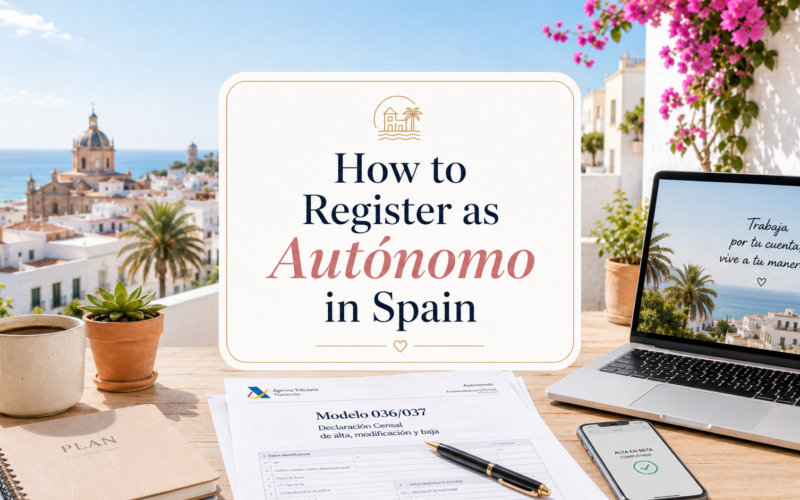
Register with Hacienda – Modelo 036 or 037
- Modelo 037 is the simplified version used by most new autónomos – covers basic registration and VAT election
- Modelo 036 is the full version for more complex situations: multiple business activities, intra-EU trade, VAT groups
- This declaration tells Hacienda you are starting an economic activity, your IAE code, your VAT status and your preferred tax calculation method (estimación directa simplified is standard for most expats)
- Submit online at sede.agenciatributaria.gob.es with your digital certificate or Cl@ve, or in person at your local Hacienda office. Your gestoría can submit on your behalf with a power of attorney.
- Do this before or on the day you start working – not after your first invoice.
Register with Social Security – Modelo TA0521
- This registers you in the Régimen Especial de Trabajadores Autónomos (RETA) – Spain’s self-employed social security regime
- Must be communicated before you start the activity. Social Security allows registration up to 60 calendar days before the activity begins.
- You select your monthly contribution base – linked to your projected income under the new income-based system (2023+)
- Provide your Spanish bank account details – Social Security will direct debit your monthly contribution on the last working day of each month
- Submit online at sede.seg-social.gob.es or in person at your local Social Security (Seguridad Social) office
Choose your IAE code correctly
- The IAE (Impuesto sobre Actividades Económicas) code classifies your economic activity. It determines your IVA treatment and some aspects of your tax filing
- Common IAE categories exist for consultants, IT professionals, software developers, marketing services, writers and other professional activities, but the exact code depends on your real activity. Do not guess this yourself if your work covers multiple services.
- A gestoría should confirm the correct IAE code before submitting Modelo 036 or 037. Choosing the wrong code can create VAT, withholding and compliance problems later.
- Choosing the wrong code creates compliance problems – the Agencia Tributaria’s IAE table lists all codes at agenciatributaria.gob.es
- If you work across multiple activity types, a gestoría can identify the most appropriate primary code and whether additional codes are needed
Set up quarterly tax declarations
- IVA (VAT) – Modelo 303: filed quarterly (April, July, October, January) reporting IVA charged on invoices vs IVA paid on business expenses. Annual summary via Modelo 390.
- IRPF payments on account – Modelo 130: quarterly income tax advance payments, 20% of net profit. Annual declaration via Modelo 100 in April-June.
- Factura format: your invoices must be legally compliant – date, sequential number, your full name, NIE, client details, concept, base amount, IVA rate and total. Software like Holded generates these automatically.
- Missing a quarterly declaration results in automatic fines. The usual deadlines are 1-20 April, July and October, and 1-30 January for Q4. If you pay by direct debit, the closing date is often earlier. Calendar these before you issue your first invoice.
Set up your business bank account
- While not legally required, keeping a separate bank account for autónomo income and expenses makes quarterly tax filing significantly simpler
- Your Social Security direct debit will come from this account
- All business income in and business expenses out through one account means clean records with no mixing of personal and professional
- BBVA and Sabadell both offer basic autónomo-friendly accounts; N26 Business is an option for digital-first users who have a Spanish address
Save Time – Let a Gestoría Handle Your Autónomo Registration
The paperwork is manageable if your Spanish is good and you have a digital certificate. But most expat autónomos find that paying a local gestoría €150-€300 to handle the full registration is the fastest and safest approach. They have the right digital certificates, know which IAE code fits your situation, and submit everything in the right order.
How much does autónomo cost in Spain? (2026 numbers)
The autónomo cost question gets more complex every year because Spain has been reforming the contribution system. Understanding what you will actually pay before you register matters – it changes the business case significantly.
Social security contributions (cuota de autónomo)
From 2023, Spain replaced the old flat-rate contribution system with an income-based model. Your monthly Social Security contribution is now linked to your actual net income, rather than a fixed amount regardless of earnings. This was good news for low earners and bad news for high earners who had been paying the minimum base regardless of income.
Social security contribution – how it works in 2025/2026
The new system has multiple net income brackets. At the lower end (monthly net income below approximately €670), contributions are at the minimum. At the higher end, contributions rise progressively. Important: rates are reviewed annually. The Social Security (Tesorería General de la Seguridad Social) publishes current rates at seg-social.es – always verify the current year’s table before registering. New autónomos who meet eligibility criteria may qualify for a reduced contribution rate in their first year. Ask your gestoría to confirm current rates and eligibility before choosing your contribution base.
📌 2026 contribution table – official source
For 2026, autónomo contributions are based on declared net income brackets. The lowest reduced bracket starts at net returns up to €670/month, but the exact cuota depends on the chosen contribution base within the allowed range. Always check the current TGSS table at seg-social.es before registering, because the bracket system is updated and regularised against your actual income each year.
⚠️ Social Security contribution – Frank’s honest note
The old flat-rate system has changed, but a reduced first-year cuota still exists for eligible new autónomos. Social Security currently describes this reduced cuota as €80/month for the first 12 months, with the MEI contribution added on top, bringing the total to around €88.64/month. After the reduced period, contributions move into the income-based bracket system. Always ask your gestoría to confirm whether you qualify before registering.
Income tax (IRPF): how it works for autónomos
As an autónomo, you pay IRPF (Impuesto sobre la Renta de las Personas Físicas) on your net profit – income minus allowable deductions. This is Spain’s equivalent of income tax. You pay quarterly on-account payments of 20% of your quarterly net profit via Modelo 130, then reconcile with the actual annual figure in your April-June tax declaration.
| Taxable income band | Approx. progressive IRPF band | Important note |
|---|---|---|
| Up to €12,450 | ~19% | Reference band only |
| €12,450 – €20,200 | ~24% | Reference band only |
| €20,200 – €35,200 | ~30% | Reference band only |
| €35,200 – €60,000 | ~37% | Reference band only |
| Over €60,000 | ~45-47% | Reference band only |
These are simplified reference bands only. Spain’s IRPF is progressive and split between state and regional components, so the final rate depends on your autonomous community, personal allowances and deductions. In Andalucía, the regional component differs from Madrid, Cataluña, Valencia or the Balearics. Always ask your gestoría to calculate the real expected tax based on your residence and family situation. The Social Security contributions themselves are deductible from your income for IRPF purposes.
IVA (VAT): quarterly declarations
Most autónomos charge 21% IVA on their invoices. Reduced rates apply to some services (10% for some professional services, 4% for basic goods). Some services are IVA-exempt – education, healthcare, financial services. If you invoice Spanish clients, you charge IVA and declare quarterly. If you invoice EU business clients outside Spain, the reverse charge mechanism applies and you do not charge Spanish IVA. If you invoice non-EU clients, IVA treatment depends on the service type.
The IVA you collect from clients is not your money – it belongs to Hacienda. The IVA you pay on business expenses is reclaimable. The quarterly Modelo 303 calculates the net amount you owe or are owed.
IRPF withholding on invoices to Spanish clients
If you invoice Spanish companies or professionals for certain professional services, your invoice may need to include IRPF withholding (retención). This means the client withholds part of the invoice amount and pays it directly to Hacienda on your behalf. The standard professional withholding rate is often 15%, though reduced rates are sometimes available for professionals in their first years of activity. If your invoice includes a retention, you write it as a deduction on the invoice total – the client pays you the net amount and reports the withheld portion to Hacienda.
If you mainly invoice foreign clients outside Spain, this may not apply. Withholding requirements depend on your IAE activity type and the nature of your clients. Ask your gestoría whether your specific activity requires IRPF withholding on domestic invoices before you start billing Spanish businesses.
Accounting software for autónomos: why you need it
The paperwork reality of being autónomo – quarterly declarations, proper invoice formatting, expense tracking, IVA reconciliation – is genuinely manageable if you have the right software. Trying to track it in a spreadsheet is how people miss deductions and make filing errors.
Good autónomo accounting software handles: legally compliant invoice generation, expense categorisation, quarterly declaration summaries for your gestoría, IVA tracking and annual income summaries. The cost is fully deductible as a business expense.
What autónomo accounting software should do
Invoice generation in legally compliant Spanish format with automatic sequential numbering. Expense tracking with category labels for deductions. IVA tracking – separate IVA collected vs IVA paid. Quarterly summary reports that you send to your gestoría or use to complete Modelo 303 and 130 yourself. Bank reconciliation ideally connecting to your Spanish bank account.
Try Holded Free for 15 Days – Built for Spanish Autónomos
Holded is a Spanish cloud accounting platform used by thousands of autónomos and small businesses. Spanish-language and English-language interface, invoice generation that complies with Spanish factura requirements, IVA tracking and quarterly report exports for your gestoría.
Affiliate link – we may earn a commission at no cost to you.
Autónomo vs setting up an SL company in Spain
At some point, most successful autónomos face this question. The short answer: autónomo is simpler and lower-cost to set up, but SL (Sociedad Limitada) can be significantly more tax-efficient once your net profit exceeds approximately €40,000-€50,000 per year.
| Factor | Autónomo | SL (Sociedad Limitada) |
|---|---|---|
| Setup cost | ~€0 (gestoría fee) | €1,000-€3,000 (notary + registration) |
| Minimum capital required | None | €1 minimum (since 2023 reform) |
| Tax on profits | IRPF (19-47%) | Corporate tax 25% (15% first 2 years) |
| Personal liability | Unlimited personal liability | Limited to company assets |
| Monthly admin cost | Lower (gestoría + software) | Higher (more complex accounting) |
| Best suited to | Net profit under €40,000/year | Net profit over €40,000-€50,000/year |
The tax efficiency of an SL comes from the ability to split income between salary (taxed at personal IRPF rates) and dividends (taxed at savings income rates, 19-28%), and from retaining profits in the company at the lower corporate tax rate rather than withdrawing everything as personal income. If you are earning €80,000/year as an autónomo, the IRPF rates at the higher brackets make a well-structured SL meaningfully cheaper in total tax.
The SL also provides limited liability protection, which matters if your business involves any kind of financial risk. As an autónomo, your personal assets are at risk if the business has debts or legal claims. For consultants, bloggers and low-risk freelancers, this rarely matters. For businesses with suppliers, contracts or employees, it matters more.
💡 When to consider switching from autónomo to SL
- Your net annual profit consistently exceeds €40,000-€50,000
- You want to retain profits in a company structure rather than withdrawing everything as personal income
- Your business involves contracts, suppliers or employees where limited liability matters
- You have partners or co-founders – SL handles ownership splits cleanly; autónomo does not
Tax deductions for autónomos in Spain
The deductions system is one of the most underused advantages of autónomo status. Most expat autónomos claim far fewer deductions than they are entitled to, simply because they don’t know the rules. Your gestoría and accounting software should be tracking these systematically from day one.
Home office deduction
If you work from home and have declared part of your home as affected to the activity, utilities can be deducted using Hacienda’s standard formula: 30% of the proportion of the home used for business. For example, if your office is 20% of the property, the standard utilities deduction is 30% × 20% = 6% of eligible utilities. Rent or ownership-related costs follow different proportionality rules and should be confirmed with your gestoría.
Two important limitations: the deduction applies more cleanly to utility expenses (electricity, internet, water) than to rent or mortgage. And the dedicated workspace needs to be genuinely used for work – a dining table you occasionally open a laptop on does not count. A dedicated office room does.
Vehicle and travel expenses
Vehicle expenses are deductible if the vehicle is used for business purposes. The rules are strict: in Spain, Hacienda typically allows 50% deduction on vehicle expenses for autónomos who use a car for both personal and business use, but only if you can demonstrate the business use. Fuel, insurance, maintenance and depreciation are all potentially deductible in proportion to business use. Keep a mileage log if you plan to claim vehicle expenses.
Travel expenses for business purposes – flights, hotels, trains for client visits or conferences – are fully deductible with proper documentation. Always get receipts in your name as an autónomo (or in your business name) and retain them with a note of the business purpose.
Professional development and software
This is the deduction most autónomos underuse. Online courses, industry conferences, books and publications relevant to your work are fully deductible. Software subscriptions used for the business – accounting software, design tools, project management, hosting, email marketing platforms – are fully deductible. The gestoría fee itself is deductible. Health insurance premiums, up to a certain annual limit, are deductible for autónomos.
💡 Deductions checklist for autónomos
- Social security contributions – fully deductible from income for IRPF purposes
- Home office – proportion of rent, electricity, internet, water (renters)
- Professional services – gestoría, lawyers, consultants used for the business
- Software and subscriptions – accounting software, tools, hosting, cloud services
- Mobile phone – up to 50% if used for business
- Professional development – courses, books, conferences, memberships
- Health insurance – generally deductible up to €500 per covered person per year for the autónomo, spouse and children under 25 living with them; €1,500 for persons with disabilities. Verify current limits with your gestoría as these can change with annual budget laws.
- Vehicle expenses – proportional to business use, with documentation
- Business travel – flights, accommodation, transport for client or business purposes
- Marketing and advertising – website costs, hosting, advertising spend
Track Your Autónomo Deductions Automatically with Quaderno
Quaderno connects to your invoicing and payment systems to track income and deductible expenses automatically. Particularly useful if you invoice international clients in multiple currencies or sell through platforms like Stripe.
Affiliate link – we may earn a commission at no cost to you.
💰 Practical rule of thumb: what to set aside each month
- IVA collected: do not spend it. Keep the 21% IVA you charge on invoices completely separate – it is not your money and Modelo 303 will require it quarterly.
- IRPF: set aside 20-30% of your net profit (after expenses and Social Security) until your gestoría gives you a more accurate estimate based on your actual income and deductions.
- Social Security: budget the monthly cuota as a fixed overhead, because it is charged every month regardless of whether you had a good or bad month.
- Gestoría and software: budget €70-€200/month depending on complexity and how much you want to manage yourself.
Common mistakes expat autónomos make in Spain
Registering late – after the first invoice
You should register with Social Security before starting the activity – registration can be made up to 60 days before. Register with Hacienda before or on the date you begin invoicing. Issuing invoices before registration can create tax and Social Security problems.
Fix: register before you issue your first invoice. If you have already invoiced, talk to a gestoría immediately about how to regularise the situation.
Choosing the wrong IAE code
The IAE code determines how your activity is classified for tax purposes. The wrong code can cause compliance problems in quarterly declarations and audits.
Fix: confirm your IAE code with a gestoría before submitting Modelo 036/037. Changing it after registration requires a new declaration.
Missing a quarterly declaration deadline
IVA (Modelo 303) and IRPF payments on account (Modelo 130) have fixed quarterly deadlines. Missing them results in automatic surcharges and fines, which compound with time.
Fix: put all declaration deadlines in your calendar on day one. For most quarterly autónomo filings, the usual deadlines are 1-20 April, July and October, and 1-30 January for the fourth quarter. If you pay by direct debit, the deadline is often earlier. Or pay a gestoría to handle them.
Mixing personal and business bank accounts
Running autónomo income through your personal account and mixing personal expenses with business expenses makes quarterly filing a nightmare and increases the risk of missing deductions.
Fix: open a dedicated bank account for autónomo activity from day one. This makes accounting software reconciliation clean and deductions clear.
Not claiming legitimate deductions
Most expat autónomos significantly underclaim deductions in their first 1-2 years because they don’t know what is allowable. This means paying more tax than necessary.
Fix: use accounting software to track all business expenses from the start and work through the deductions list with your gestoría at your first annual tax return.
Forgetting to deregister when leaving Spain
If you leave Spain and stop being tax resident, you need to formally deregister from both Hacienda and Social Security. Failing to do so means Social Security keeps charging your bank account.
Fix: treat deregistration as seriously as registration. Submit the cancellation declarations to both Hacienda (Modelo 036/037) and Social Security within the required timeframe before leaving.
Ready to Register? Get Step-by-Step Help from a Local Gestoría
The registration process is manageable, but the first quarterly declarations, the right IAE code selection and the deductions setup all benefit from professional guidance. A Málaga or Marbella-based gestoría with experience in expat autónomos will save you more than their fee in avoided mistakes in the first year alone.
Autónomo and the Digital Nomad Visa: what expats need to know
Digital Nomad Visa applicants can be either employees of a foreign company or self-employed professionals with foreign clients. The two situations have different implications for autónomo and Social Security.
If you are employed by a foreign company and your employer handles your social security contributions in another EU/EEA country, you may not need to register with Spanish Social Security – but you need a valid international social security agreement or A1 certificate to prove this. Without one, becoming Spanish tax resident may trigger Spanish Social Security obligations regardless of where your employer is based.
If you are self-employed with foreign clients and become Spanish tax resident, you are likely required to register as autónomo in Spain and pay Spanish Social Security contributions. The fact that your clients are outside Spain does not change your obligations as a Spanish tax resident.
⚠️ Digital Nomad Visa + autónomo: this is a specialist area
The intersection of the Digital Nomad Visa, Spanish Social Security obligations and international tax treaties is genuinely complex. Generic advice – including this guide – is not a substitute for advice from an immigration lawyer or gestoría who specialises in Digital Nomad Visa holders. This is an area where incorrect assumptions cost money. Get a proper consultation before invoicing from Spain on a DNV.
Autónomo in Spain FAQ
How much does it cost to become autónomo in Spain?
The registration itself is free through Hacienda and Social Security. The main ongoing costs are: monthly Social Security contributions (based on your net income under the current income-based system – verify current rates at seg-social.es), quarterly and annual tax filing (if you use a gestoría, typically €50-€150/month depending on complexity), and accounting software (€15-€60/month). The gestoría is not mandatory but is strongly recommended for expats who are not fluent in Spanish tax law. For most expats, the total autónomo overhead outside of actual tax payments runs €100-€250/month.
Can I register as autónomo without a NIE?
No. The NIE (Número de Identificación de Extranjero) is required to register with both Hacienda and Social Security. Without it, neither registration form can be completed. Getting your NIE should be the first step. EU citizens can get a NIE relatively quickly through the Foreigners Registration process; non-EU citizens need to follow the relevant immigration and visa route first. For a full guide to the NIE process, see our Málaga expat guide and the NIE section within it.
Do I need a gestoría to register as autónomo?
Technically no – the process can be done entirely yourself if you have a digital certificate or Cl@ve PIN and your Spanish is sufficient to navigate the Hacienda and Social Security online systems. Practically, most expat autónomos find that a gestoría is worth the cost. The registration itself is a one-time fee of €100-€300. For ongoing compliance – quarterly declarations, annual return, deductions advice – a gestoría typically costs €50-€150/month and handles everything. The alternative is managing it yourself with good accounting software, which works for people who are organised and Spanish-comfortable.
How long does autónomo registration take?
The Hacienda registration (Modelo 036/037) is usually processed same-day or within a few days when done online. The Social Security registration (RETA) typically takes a few days to 2 weeks. From submitting the paperwork to being fully registered with both systems, allow 1-3 weeks. With a gestoría managing the process and having the right documents ready, it is usually complete within a week.
What happens if I don’t register as autónomo when I should?
Hacienda can issue fines for operating without autónomo registration, for missing tax declarations, and for unpaid Social Security contributions. Social Security fines for non-registration are typically calculated on the contributions that should have been paid. The amounts are not trivial. Additionally, undeclared income from self-employment is treated as tax fraud, not a minor administrative issue. The regularisation process exists but is considerably more painful than registering on time. If you have been working without autónomo registration, talk to a gestoría before Hacienda contacts you – voluntary regularisation is treated more favourably than discovered non-compliance.
Is autónomo in Spain good or bad compared to other European countries?
The Social Security contribution is the main criticism – it applies regardless of income at or above a minimum base, unlike some other European countries where contributions scale more directly with income. The 2023 income-based reform improved this significantly for low earners. The tax rates themselves are comparable to Northern Europe at middle income levels but become significant at higher income levels, particularly above €60,000 net. The deductions system is reasonable and a good gestoría will maximise it. Many expats find the overall package – combined with Spain’s cost of living advantage – works well. The combination of full Spanish healthcare entitlement through Social Security and reasonable middle-income tax rates makes it viable for most professional freelancers. For a complete picture of expat costs in Spain, read our expat banking guide and the broader cost of living sections in our Málaga guide.
Sources and references

📚 Sources for this autónomo guide
- Agencia Tributaria – official source for Modelo 036, Modelo 037, Modelo 130, Modelo 303 and IAE code tables. Verified June 2026.
- Tesorería General de la Seguridad Social – current autónomo contribution rates, income brackets and RETA registration process. Always verify current year rates here before registering.
- BOE (Boletín Oficial del Estado) – Spanish official state gazette, primary source for autónomo legislation including the 2023 contribution reform law.
- IRPF bracket rates – national rates are published by the Agencia Tributaria; regional rates are set by each comunidad autónoma and published separately.

Susan Jordan is editor at StartLifeInSpain.com, where she writes practical guides about Spanish cities, relocation, lifestyle and everyday life in Spain. Based in Fuengirola on the Costa del Sol, Susan brings local insight into the region’s towns, communities and expat lifestyle. When she is not writing, she enjoys sailing, spending time on the golf courses and exploring the coastal towns of southern Spain.