




How to Get a NIE Number in Spain: Complete Expat Guide (2026)
A NIE number in Spain is the foreigner identification and tax number you need for most serious Spanish paperwork: buying property, registering as autónomo, signing at a notary, filing taxes, opening normal Spanish banking relationships and dealing with official administration.
I got my NIE number in Spain through a gestoría at a notary office in Fuengirola more than ten years ago. My wife got hers the same day. The process took about a week from start to finish, cost a small gestoría fee on top of the official government charge, and we had both numbers in hand by the time we signed our paperwork.
The DIY route is cheaper. It is also slower, more dependent on appointment availability, and easier to get wrong if your justification document is weak. This guide explains both routes honestly: how to apply yourself with EX-15 and Modelo 790, when to use a gestoría, what documents to bring, what a NIE number in Spain does not do, and what still trips expats up in 2026.
Last updated: June 2026. NIE procedures are managed by the Spanish Policía Nacional. Processing times, appointment availability and exact fees can change. Always verify current details through the official Cita Previa Extranjería portal and the Policía Nacional NIE procedure page before applying.
NIE number Spain – quick answer
NIE number Spain – what you need to know first
What it isForeigner ID and tax number – format X-1234567-A
Who needs itAny non-Spanish national doing anything formal in Spain
Does it expireThe number does not expire – but some institutions may ask for a recent certificate
Official feeAround €10 via Modelo 790 Código 012 – verify before paying
Gestoría route€50-150 extra – usually easier, fewer mistakes, often faster
Time to get itSame day to a few days after appointment if documents are complete
Appointment availability (peak)4-6 weeks wait in summer – book early
✅ Frank’s rules for getting a NIE number in Spain
- Get the NIE before you need it. The appointment delay is usually the problem, not the appointment itself.
- Bring copies of everything. In Spanish paperwork, one missing photocopy can waste the whole morning.
- Do not rely on a self-written explanation. Bring a real justification document – a signed contract, not a letter.
- Use a gestoría if money is on the line. Property purchases, autónomo registration and tax deadlines are not the time to save €100.
- Do not confuse NIE with residency. A NIE number in Spain is an identification number. It does not make you legally resident.
What is a NIE number in Spain
NIE stands for Número de Identificación de Extranjero – Foreigner Identification Number. It is a unique tax and identification number assigned to non-Spanish nationals who need to carry out any official transaction in Spain.
⚠️ What a NIE number does not give you
- A NIE number in Spain does not give you the right to live in Spain
- A NIE does not give you the right to work in Spain
- A NIE is not proof of tax residency in Spain
- A NIE is not the same as the TIE residence card
- A NIE is not the same as empadronamiento (registration at your town hall)
What a NIE number looks like
FormatX-1234567-A
First characterLetter: X, Y, or Z
Middle section7 digits
Last characterCheck letter (A-Z)
Changes if you move region or get residencyNever – it is permanent and national
The NIE is not a residency permit. Getting one does not give you the right to live or work in Spain. It is purely an identification and tax reference number. Many expats confuse it with residency – they are completely separate processes.
Who needs a NIE number in Spain
The short answer: anyone doing anything formal in Spain. The longer answer covers almost every interaction with the Spanish financial and legal system.
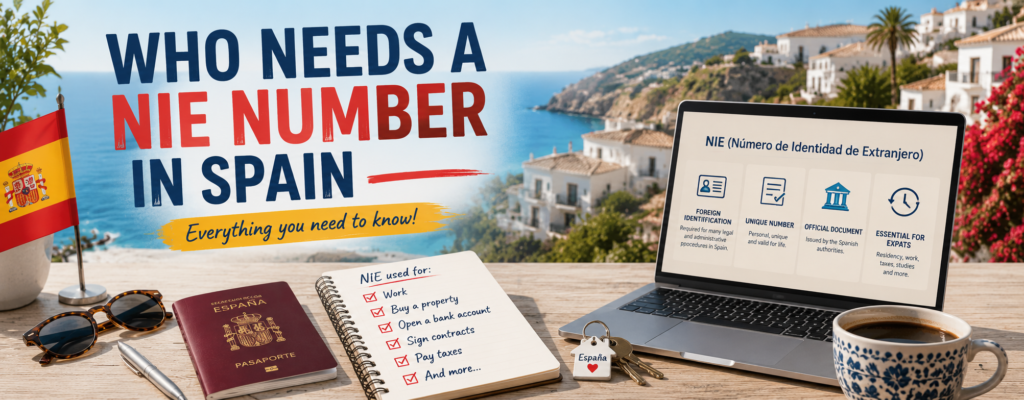
✅ When you need a NIE number in Spain
- Opening a Spanish bank account – most Spanish banks will either ask for a NIE or make the process much easier once you have one. Some non-resident accounts can be opened with a passport and extra documentation, but for normal Spanish banking the NIE quickly becomes necessary. See our guide to the best bank accounts for expats in Spain for NIE-free alternatives while you wait
- Buying or renting property – Spanish notaries will not process a property purchase without a valid NIE from both parties. Long-term rental contracts typically require one too
- Registering as autónomo – you cannot file a Modelo 036 without a NIE. Read our complete guide to registering as autónomo alongside this one
- Buying or registering a vehicle – required at the DGT for any vehicle transaction
- Getting a Spanish driving licence – mandatory for the exchange or new application process
- Applying for residency or immigration documents – the NIE is commonly assigned during or before the process, but the exact route depends on your visa type, nationality and application category
- Accessing public healthcare through the SNS – the NIE is often part of the paperwork, but healthcare registration usually also depends on residency status, social security entitlement and local registration (empadronamiento)
- Filing any Spanish tax return – IRPF, IVA, non-resident income tax – all require a NIE as your tax identifier
- Enrolling in Spanish state education – required for school registration
If you are planning any kind of formal life in Spain, get your NIE before you need it. The process takes longer than expected and the consequences of not having one at the wrong moment – a property completion, a business launch, a tax deadline – are significant.
NIE vs TIE – the difference that confuses most new expats
NIE is the number. TIE (Tarjeta de Identidad de Extranjero) is the physical identity card. They are related but not the same thing, and the distinction matters when Spanish institutions ask to see documents.
| NIE (number) | TIE (card) | |
|---|---|---|
| What it is | A unique identification number | A physical identity card containing your NIE |
| Who gets it | Non-residents and residents | Non-EU residents and some foreign residents issued a physical identity card |
| Physical form | A4 paper certificate | Credit-card sized ID card |
| When needed | Any formal transaction in Spain | Once issued, proves your residence status and displays your NIE number |
| Relationship | Comes first – the number always exists before the card | Cannot have a TIE without first having a NIE |
| Costa del Sol context | Property buyers, non-resident owners get a NIE | Those moving full-time on a visa get a TIE |
Most expats start with a NIE as a non-resident and apply for a TIE card once they have secured residency. If someone asks for your residency card and you hand them a paper NIE certificate, those are two different documents – know which one is being requested before you arrive.
Three ways to get a NIE number in Spain
There are three practical routes. Which one suits you depends on where you are, how soon you need the number, and how comfortable you are with Spanish paperwork in person.
| Route | Where | Cost | Speed | Best for |
|---|---|---|---|---|
| Spanish consulate | Your home country | Around €10 – verify before paying | Variable – can be months | Pre-move applicants with time |
| DIY in Spain | Policía Nacional / Oficina Extranjería | Around €10 – verify before paying | Same day if documents complete; 4-6 week appointment wait in peak | Budget-conscious expats comfortable with forms |
| Gestoría / lawyer | In Spain via professional | €60-162 total | Often 1-2 weeks when appointments and documents are straightforward | Property buyers, autónomos, anyone who wants it done without queues |
✅ Why use a gestoría
- Often faster in total – a good gestoría can move quickly once your documents are in order
- They know exactly which justification documents work for your situation
- For property buyers – the notary’s gestoría usually handles it as part of the purchase
- Can apply with power of attorney – you do not need to be present
- They handle rejections – if a document is wrong, they fix it without a wasted trip
📋 Why do it yourself
- Cheapest option – under €15 total if documents are complete
- Straightforward if your situation is simple (employed in Spain, clear property contract)
- Works well outside peak season when appointments come up in 1-2 weeks
- Good introduction to navigating Spanish administration
Which NIE route should you choose?
| Your situation | Best route | Why |
|---|---|---|
| Buying property in Spain | Gestoría or lawyer | The deadline matters and your arras contract is strong justification. The notary’s gestoría often handles it as part of the purchase. |
| Moving in 3-6 months | Spanish consulate in your home country | You can start before arrival if your consulate offers appointments. Check availability early – some have long waits. |
| Already in Spain, simple situation | DIY appointment | Cheapest route if you have a clear, documentable reason and time to wait for a cita previa. |
| Registering as autónomo | Gestoría | The NIE, Hacienda registration and Social Security steps should be coordinated. A gestoría does all three. |
| No Spanish, no printer, limited patience | Gestoría | The saved time and avoided mistakes are worth the fee. One wrong document and you rebook from scratch. |
Step-by-step: the DIY NIE application in Spain
If you are applying yourself, here is exactly what the process looks like in 2026.
Book a cita previa via the official Cita Previa Extranjería portal
- Go to the official Cita Previa Extranjería portal and book an appointment at your local Oficina de Extranjería or National Police station
- Select your province, then look for NIE and certificates: Policía – Expedición de NIE e Certificados
- In Málaga province: main offices are in Málaga city (Avenida de la Aurora) and Marbella (Calle Manuel Azaña). Marbella serves the western Costa del Sol including Fuengirola, Benalmádena and Estepona
- Book whichever has the earlier slot – the process is identical at both locations
Complete form EX-15
- Download form EX-15 from the Spanish government website and fill it in carefully
- EX-15 is the form used to request a NIE number in Spain. EX-18 is mainly used by EU/EEA citizens registering as residents in Spain. Non-EU visa holders applying for a TIE usually follow a different process – check which form matches your status before filling anything in
- The form asks for your personal details, your reason for needing a NIE, and your contact information in Spain
- Print and bring at least two completed copies to the appointment
Pay the fee via Modelo 790 Código 012
- Download Modelo 790 Código 012 and complete it with your personal details
- Take the completed form to a Spanish bank branch and pay the fee (around €10). Always verify the current amount before going to the bank. The bank stamps the form as proof of payment
- Not every branch processes Modelo 790 for non-account holders – call ahead or use a branch where you have an account
- Keep the stamped receipt. Without it, you cannot proceed at the appointment
Prepare your justification document
- This is where most DIY applications fail. The EX-15 asks for your reason for needing a NIE, but the officer at the window wants to see physical evidence of that reason – not just your word for it
- Strongest justification: a signed arras contract (property deposit agreement). If you are buying property in Spain, this is usually one of the strongest justification documents you can bring
- Also accepted: signed employment contract from a company registered in Spain, formal pre-approval or letter from a Spanish bank, enrollment documentation from a Spanish educational institution, business registration documents for a Spanish company
- Often weak or rejected: a general letter stating you intend to move to Spain without supporting documentation. A neighbour of mine was turned away twice with exactly this – the second time after driving to Marbella from Fuengirola for the appointment
- If you are registering as autónomo, a letter from your gestoría confirming the impending registration with Hacienda typically works. Ask your accountant to provide this before you apply
- Have the justification document confirmed and printed before you book the cita previa – not the night before the appointment
Attend the appointment
- Bring: passport + two copies of the photo page, two completed EX-15 forms, stamped Modelo 790 receipt, justification document + copy
- Arrive on time and have everything ready to hand over without searching through a bag
- The appointment itself is usually 15-20 minutes
- If everything is in order, you receive the NIE certificate the same day or within a few days – an A4 sheet with your name, passport details and NIE number. Keep a copy
Which justification document do you need?
| Reason for NIE | Strong supporting document | Risk level |
|---|---|---|
| Buying property | Signed arras contract, reservation contract or lawyer/notary letter | Low |
| Starting work in Spain | Spanish employment contract or employer letter from company registered in Spain | Low-medium |
| Registering as autónomo | Gestoría or accountant letter explaining pending registration with Hacienda | Medium |
| Opening a Spanish bank account | Bank pre-approval letter or application confirmation | Medium |
| General intention to move to Spain | Self-written explanation only | High – often not sufficient on its own |
What the NIE appointment is actually like
Most guides describe the NIE process as a series of steps. What they do not describe is what it actually feels like to be in the room, which is where the anxiety usually lives for first-time applicants.
You walk into a waiting area, take a number or check in at reception, and wait to be called. The appointment window is usually a single officer behind a counter – sometimes a glass partition, sometimes not. You hand over the documents in order: passport and copies first, then the EX-15 forms, then the Modelo 790 receipt, then the justification. The officer checks each one and enters your details into their system.
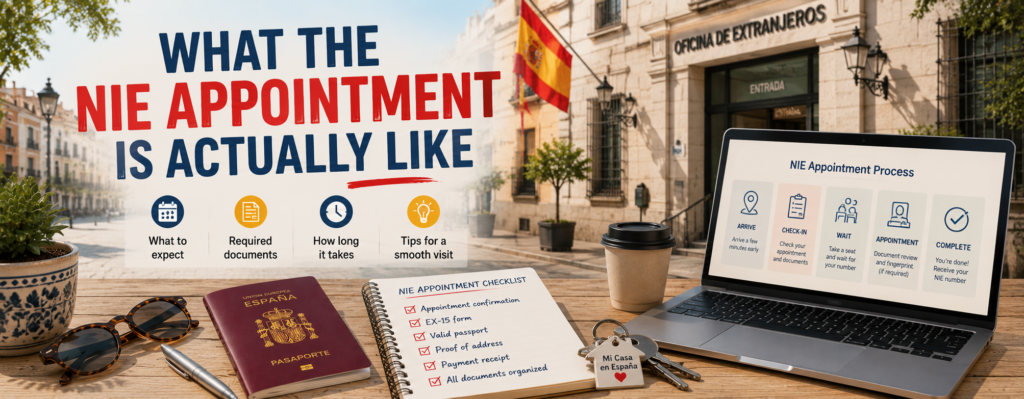
What they are looking for: that your passport matches your EX-15, that the Modelo 790 is correctly stamped with the right amount, and that your justification is a real document rather than a letter you wrote yourself. They are not trying to catch you out. They are processing a stack of applications and want the folder to be clean so they can move through it efficiently. If something is missing, they will tell you what it is and you will need to rebook.
If everything is correct, the officer enters your data and either hands you the printed NIE certificate at the window or tells you to collect it in a few days. Some offices issue the certificate the same day when the appointment goes smoothly; others may ask you to return or wait a few days. Do not assume same-day issue until the office confirms it on the day.
The whole appointment takes 15-20 minutes and feels anticlimactic after the preparation it requires. My wife and I sat in the Fuengirola notary’s office for longer discussing where to have lunch than we spent at the NIE appointment itself. The gestoría had already done the hard part.
Documents needed for a NIE application
Bring originals and copies of everything. Spanish offices frequently ask for a photocopy when none was mentioned in the original requirements. Having extras saves a wasted trip.
📋 NIE application document checklist
- Original passport and at least two photocopies of the photo page
- Completed EX-15 form – two printed copies, fully completed before you arrive
- Stamped Modelo 790 Código 012 – the bank-stamped payment receipt
- Justification document – property contract, employment letter, bank application, etc. Plus a copy
- Passport-sized photo – not normally required for a basic NIE certificate, but some offices or related procedures may ask for one. Bringing one is cheap insurance
⚠️ Applying for two people on the same day
If two people are applying – as my wife and I did in Fuengirola – each person needs their own complete set of documents. There are no shortcuts for multiple applicants in a single appointment. Book accordingly and prepare two separate document folders before the day.
Costs of getting a NIE number in Spain
NIE costs breakdown
Official government fee (Modelo 790)Around €10 per person – verify current amount
DIY total costUnder €15 per person
Gestoría fee€50-150 per person on top of official fee
Gestoría total cost~€60-162 per person
Property purchases (Costa del Sol)Often included in notary/legal package – no separate fee
The gestoría fee buys you a faster process, fewer trips, and someone who knows exactly which documents are needed for your specific situation. For property purchases on the Costa del Sol, this is usually built into the overall legal and notary costs – you may not see it as a separate line item.
How long does a NIE number take in Spain
NIE processing times – what to expect
Appointment itself15-20 minutes
Receipt of NIE certificateSame day or within a few days if documents are complete
Appointment wait (low season)1-2 weeks
Appointment wait (peak season)4-6 weeks in Málaga province
Via gestoría (total)Often 1-2 weeks when appointments and documents are straightforward
Buffer to build into plansMinimum 4 weeks before property completion or business registration
Do not plan property completions, business registrations, or visa applications around a NIE you do not yet have. The main time variable is getting the appointment – not the process itself. Build in at least four weeks as a buffer in peak season.
If you need to act while your NIE is pending: Wise and Revolut both allow you to open accounts without a Spanish NIE, which gives you a way to receive and send money in euros immediately. Private reservation agreements on property can sometimes be signed without a NIE – your lawyer or estate agent will confirm if this applies to your contract. What you cannot do without a NIE is sign anything at a Spanish notary, file a tax return, or register any activity with Hacienda or the Social Security. The interim period is manageable with the right banking setup, but it is not indefinite – start the NIE process the moment you decide to do anything formal in Spain, not once you have already committed to a timeline.
Getting a NIE number on the Costa del Sol
📍 Málaga province NIE offices
- Marbella office (Calle Manuel Azaña) – often the more practical option for western Costa del Sol applicants including Fuengirola, Benalmádena, Torremolinos, Mijas and Estepona, but appointment availability changes week to week
- Málaga city office (Avenida de la Aurora) – higher volume but not always slower. Always check both Marbella and Málaga city before deciding
- Tip: book whichever office has the earliest slot – the process and result are identical at both locations
- Property purchases on the Costa del Sol: the notary handling the sale will typically have a gestoría contact who processes both NIE applications as part of the transaction. This was the route my wife and I took in Fuengirola and it remains the standard approach. If your notary does not offer this, ask for a referral to a local gestoría that handles expat paperwork regularly
- Timing relative to property completion: the window between the arras (deposit contract, typically 10% of the purchase price) and the escritura (notarised completion) is usually 30-60 days. That is plenty of time for a NIE if you contact a gestoría the same week you sign the arras. The arras contract itself is your justification document. Do not wait until the completion date is approaching to start thinking about the NIE – at that point you are creating unnecessary pressure on a process that takes what it takes
- What to tell a gestoría: call and say you are buying property in the province, give them the expected completion date, and ask if they can handle the NIE application as part of the purchase. Most confirm within the day and tell you exactly what to bring. A good gestoría on the Costa del Sol has done this hundreds of times and will move faster than you expect
Common mistakes that cost expats a wasted trip
⚠️ Five mistakes that ruin NIE applications
- No justification document. Without documented proof of why you need a NIE, the application is rejected on the spot. Have your paperwork in hand before booking the appointment – not after
- Not bringing copies. Spanish offices ask for photocopies of everything. Bring two copies of every document in your folder. Do not assume a printer or copy shop will be nearby
- Wrong bank for Modelo 790. Not every branch processes this form for non-account holders. Call ahead or use a branch where you hold an account
- Missing the cita previa. If you miss your appointment, you go back to the queue. Confirm the day before and arrive with time to spare
- Confusing NIE with TIE. If an institution asks for your residency card (TIE), a paper NIE certificate is not the same document. Know which one is being requested before you arrive
What to do if you lose your NIE certificate
The paper NIE certificate is easy to misplace. It is a single A4 sheet with no lamination, no photo, and no feature that makes it feel particularly important until the day you need to hand it to a notary and cannot find it.
Losing the paper does not mean losing the number. Your NIE is registered in the national database the moment it is issued and does not disappear if the certificate is lost. What you need is a duplicate certificate – officially called a certificado de NIE – which you apply for through the same system used for the original.
The process for obtaining a duplicate is the same as the original application: cita previa at the Oficina de Extranjería or Comisaría Nacional, the same Modelo 790 fee, and the same documents. The difference is that your justification this time is simpler – you are an existing NIE holder requesting a copy of your own number, and a declaration to that effect is generally accepted. A gestoría can handle this for you in the same way as the original application.
One practical note: Spanish institutions that have dealt with you before – your bank, your gestoría, your notary – already have your NIE on file. If you need to prove your NIE to an existing contact while you wait for the duplicate certificate, ask them to look it up in their records. In most cases they can confirm it immediately. The certificate is proof for new institutions that have no prior relationship with you.
Official NIE links and forms
📚 Official NIE resources
NIE number Spain – frequently asked questions
Can I get a NIE without a Spanish address?
Yes. A Spanish address is not required for a non-resident NIE application. Your home country address is sufficient on the EX-15 form.
Does a NIE number expire?
No. NIE numbers do not expire. If you received one ten or more years ago, the number remains valid indefinitely. You do not need to renew it.
Can someone apply for a NIE on my behalf?
Yes. A gestoría or lawyer can often apply through proper authorisation or a signed power of attorney (poder notarial), depending on where and how you apply. This is standard for property buyers who cannot attend an appointment in person – which is one of the main reasons to use a gestoría rather than applying yourself.
Do I need a NIE to open a Spanish bank account?
For standard Spanish banking, usually yes. Some non-resident accounts can be opened with a passport and extra documentation, but having a NIE makes the process much easier and becomes necessary for most serious banking, tax and property situations. Wise and Revolut are useful alternatives while you wait. Our guide to opening a bank account in Spain as a non-resident covers the full picture.
Is a NIE the same as a Spanish tax number?
For non-residents, yes – the NIE functions as your NIF (Número de Identificación Fiscal) for tax purposes. Once you become a resident, your NIE number becomes your permanent tax identifier in Spain. The number itself does not change.
Do I need a separate NIE for each region of Spain?
No. A NIE is a national number and is valid across all Spanish regions and territories. One number, wherever you are in Spain.
What if my NIE application is rejected?
The most common reason for rejection is an inadequate or missing justification document. If this happens, get the correct documentation and book a new appointment. A gestoría can advise on exactly what is needed for your specific situation before your next attempt – which is the argument for using one from the start rather than discovering the requirements the hard way.
What is the difference between EX-15 and EX-18?
EX-15 is used to request a NIE number in Spain. EX-18 is mainly for EU/EEA citizens registering as residents in Spain. Non-EU visa holders who are applying for a TIE card typically follow a separate process with different forms. Always check the National Police website for the form that matches your exact nationality and immigration status before completing anything.

Frank Pedersen is the founder of Start Life in Spain, a practical website for people who want to move to Spain or understand expat life more clearly. He writes about the real challenges of starting a new life in Spain, including healthcare, insurance, importing a car, buying property, paperwork, everyday living and the practical decisions expats need to make.
Through Start Life in Spain, Frank helps readers look beyond the dream of moving south and understand what it actually takes to settle successfully in Spain. His goal is to make the process easier, more transparent and less overwhelming for future and current expats.