



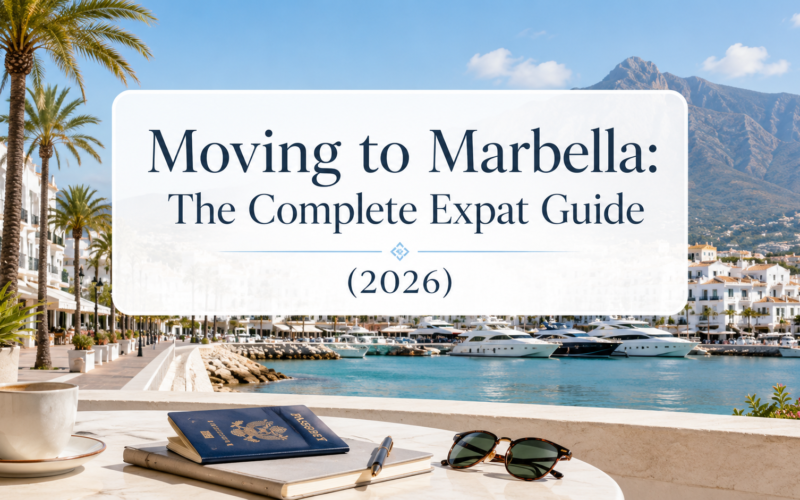
Moving to Marbella: The Complete Expat Guide (2026)
I’ve lived on the Costa del Sol for several years, based in Málaga. Marbella is 60 kilometres west – a drive I make regularly. In those years I’ve watched dozens of expats move there: some who researched it thoroughly and arrived prepared, others who packed up their lives based on a holiday impression and got a different reality.
Moving to Marbella as an expat in 2026 means dealing with a rental market tightened since 2020, property prices up 30–40% in many areas, and a cost of living that surprises people used to Spanish prices elsewhere. It also means exceptional private healthcare, some of the best international schools on the Costa del Sol, 320 days of sunshine, and one of the most established international communities in southern Europe.
StartLifeInSpain verdict
Is Marbella a good place to live as an expat?
Climate & sunshine
5/5
Private healthcare
5/5
International community
5/5
International schools
5/5
Airport & connectivity
4/5
Cost of living
3/5
Value for money
3/5
Local integration
2/5
Marbella – quick facts
Population: ~145,000 residents (doubles July–August) · Province: Málaga, Andalucía · Airport: 45 min to Málaga AGP · Sunshine: 320+ days/year · Avg temperature: 18°C annual, 30°C+ July–August · Main expat nationalities: British, Scandinavian, German, Dutch, Russian, Middle Eastern
Quick answer: is Marbella a good place to live as an expat?
Yes – for the right profile and budget. Marbella offers things hard to find anywhere else in combination: 320 days of sunshine, functional English-language infrastructure in daily life, excellent private hospitals, strong international schools, and a 45-minute drive to one of Europe’s best-connected regional airports. For expats who arrive financially prepared and with accurate expectations, the lifestyle quality is genuinely high.
The honest caveat: it is not cheap by Spanish standards. Rents have risen sharply since 2020. The long-term rental market is constrained. Summer traffic is a real quality-of-life issue for year-round residents. The monthly total – rent, car, private health insurance, school fees – surprises most first-time arrivals. Marbella rewards the prepared. It does not forgive the underprepared.
Marbella vs other Costa del Sol expat destinations
Marbella is the most famous option – but not always the best fit. Here’s how it compares to the main alternatives on the Costa del Sol, across the factors that matter most to expats.
| Factor | Marbella ★ | Estepona | Fuengirola | Málaga City |
|---|---|---|---|---|
| Monthly rent – 2-bed | €1,400–€2,000 | €900–€1,300 | €850–€1,200 | €800–€1,200 |
| International schools | ★★★★★ | ★★ | ★★★ | ★★★★ |
| English-speaking services | ★★★★★ | ★★★ | ★★★★ | ★★★★ |
| Private healthcare | ★★★★★ | ★★ | ★★★ | ★★★★★ |
| International community | ★★★★★ | ★★★ | ★★★ | ★★★★ |
| Airport distance | 45 min | 60 min | 20 min | 10 min |
| Car essential? | Yes (most areas) | Yes | Partly | No |
| Value for money | ★★★ | ★★★★★ | ★★★★★ | ★★★★ |
| Best for | Families, NLV, luxury | Quieter lifestyle, budget | Affordable beach life | City life, young expats |
Marbella wins on schools, healthcare, and international community depth. It loses on cost and value. If budget is the primary constraint, Fuengirola or Estepona give a very similar coastal lifestyle at 25-35% lower rent. If city infrastructure and public transport matter, Málaga city is the stronger choice.
Marbella neighbourhoods at a glance
San Pedro
Most Spanish
2-bed rent: €1,000-€1,600
Car: Partly needed
Budget, integration, families
Nueva Andalucía
Families
2-bed rent: €1,400-€2,200
Car: Essential
Schools, golf, expat families
Puerto Banús
Marina
2-bed rent: €1,800-€3,500
Car: Yes
Nightlife, luxury, marina
Golden Mile
Prestige
2-bed rent: €2,200-€4,500
Car: Essential
Buyers, ultra-luxury
Marbella Centre
Walkable
2-bed rent: €1,400-€1,900
Car: Optional
All-rounder, beach access
Elviria
Beach
2-bed rent: €1,000-€1,600
Car: Yes
Scandinavians, quiet, beach
West (Estepona direction) ← · · · Coastal A-7 · · · → East (Málaga direction)
Who Marbella is best for – and who it isn’t
Being honest about this upfront saves time. Not every expat profile fits Marbella well, and knowing that before you commit is more useful than finding out six months in.
Marbella is best for
- Families with children – strong international schools, safe residential areas, outdoor lifestyle year-round, good paediatric private healthcare.
- Retirees with comfortable income – excellent private healthcare, mild climate, English-speaking services, established social networks, good flight connections to home countries.
- Remote workers and digital nomads – reliable fibre internet in most areas, coworking spaces, good coffee culture, time zone proximity to the UK and Northern Europe, nomad visa route available.
- Golf enthusiasts – Nueva Andalucía alone has five golf courses within a few kilometres. The Costa del Sol has more golf courses per kilometre than almost anywhere in Europe.
- People who want an international environment – if you want to socialise primarily in English, meet people from across Europe and beyond, and operate within a community that understands the expat experience, Marbella delivers this better than almost any other Spanish city.
- NLV and Digital Nomad Visa applicants – Marbella has experienced immigration lawyers, international banks familiar with expat applications, and a well-developed support network for NLV and Digital Nomad Visa applicants.
Marbella is not ideal for
- People on tight budgets – if your monthly income is below €2,500 per person, Marbella will stretch you. There are cheaper places on the Costa del Sol – Fuengirola, Torremolinos, even Estepona – where the lifestyle is similar and the cost is 20–30% lower.
- People who want deep local Spanish integration – the international bubble in Marbella is real and it’s thick. You can live here for years speaking mainly English. That’s a selling point for some people and a red flag for others. If learning Spanish and integrating into local culture is a priority, Marbella is not where that happens most naturally.
- People without a car – you can manage without a car in Marbella Old Town or San Pedro centre, but only just. Most expat areas – Nueva Andalucía, Elviria, the Golden Mile – are not walkable for daily errands. A car changes your quality of life significantly here.
- Young people looking for city life – Marbella has nightlife, but it’s seasonal and expensive. It’s not Barcelona or Madrid. If urban energy, public transport, and a young local social scene are what you want, the Costa del Sol will feel limiting.
- People expecting quick rental access – the long-term rental market is tighter than it looks. Many properties are listed as short-term or seasonal. Finding a proper 12-month contract at a reasonable price takes time and persistence.
The reality of moving to Marbella in 2026
The Marbella people arrive expecting is often built from holiday visits in June or September – the town looking its best, restaurants buzzing, beaches postcard-ready. The Marbella people live in is a different city, particularly in January and particularly in August. Both are worth understanding before you commit.
The rental market has changed substantially since 2020. Remote working migration drove demand sharply upward. Post-pandemic lifestyle relocation added pressure. And the tourist rental market continues to pull properties out of the long-term stock and into Airbnb and seasonal lettings. A two-bedroom apartment that cost €1,100/month in 2019 is €1,600–€1,900 today in many areas. That trajectory has not reversed.
The summer reality is also worth naming directly. Between mid-June and mid-September, the N-340 coast road becomes stop-start from mid-morning. The town centre fills with tourists. Restaurants are harder to book and more expensive. Parking in the old town can take 20–30 minutes. If you’re living here year-round, you either accept this seasonal character or you plan around it – staying off the coast road in the mornings, avoiding central Marbella in peak weeks, and genuinely enjoying the calmer months that the tourists never see.
January in Marbella is genuinely one of the most pleasant places in Europe to be. 16–18°C, empty beaches, good restaurants with available tables, and a slower pace that reveals the place as it actually is for permanent residents. If you’re considering moving here, visit in January and in August before deciding. Both tell you things a summer visit alone never would.
🧑💻 Frank’s perspective – from Málaga to Marbella
I drive to Marbella quite often.
My honest take after years on the Costa del Sol – the property market advice I’d give anyone is this:
Visit the area you’re considering on a Tuesday morning in February.
Walk to the supermarket.
Drive to the school.
Sit in traffic at 8:45am.
That Tuesday morning tells you more about whether you’ll be happy there than any number of sunny Saturday visits to the promenade.
The people who move here and stay are the people who did that test first.
Best areas to live in Marbella for expats
Marbella municipality covers roughly 117 square kilometres and 27 kilometres of coastline. The neighbourhoods are distinct enough that choosing the wrong one for your lifestyle is one of the most common expat mistakes – correctable, but expensive when it means breaking a lease early.
🏛 Marbella Old Town
2-bed rent
€1,300-€1,900/mo
Car needed
Optional
Best for
Couples, singles, atmosphere
Whitewashed lanes, orange trees, excellent hidden restaurants, and genuine walkability to the beach. Apartments are typically older and smaller than newer developments further out. Summer bar noise is real – and unavoidable if you’re in the historic core.
Frank’s take: “The most charming corner of Marbella – but verify noise levels on a Friday evening before signing any lease.”
🌊 Marbella Centre
2-bed rent
€1,400-€1,900/mo
Car needed
Optional
Best for
General expats, beach access
The practical version of central Marbella – larger, more modern apartments than the Old Town, supermarkets within walking distance, and the beach is a ten-minute walk. More tourist density in summer; the specific street matters, so walk it before committing.
Frank’s take: “The sensible default for most expats wanting central living. Better space and quieter than the Old Town at similar rent levels.”
✨ Golden Mile
2-bed rent
€2,200-€4,500/mo
Car needed
Essential
Best for
High-budget buyers, villas
The five-kilometre coastal strip between Marbella centre and Puerto Banus – home to Hotel Marbella Club, Hotel Puente Romano, and the most prestigious villa addresses on the Costa del Sol. Primarily a buyers’ rather than renters’ market. Daily infrastructure is limited; a car is essential for everything.
Frank’s take: “For buyers at the top end of the market, this is where the best addresses are. Less practical as a rental base.”
⛵ Puerto Banus
2-bed rent
€1,800-€3,500/mo
Car needed
Yes
Best for
Luxury lifestyle, nightlife
Superyachts, designer boutiques (Gucci, Chanel, Hermes), active nightlife. In summer it’s genuinely intense – crowds, noise, and prices set for wealthy tourists rather than year-round residents. In winter it quietens significantly, which either suits you or doesn’t.
Frank’s take: “Visit in July before committing to living here. The summer tourist concentration is a real quality-of-life factor for permanent residents.”
⛳ Nueva Andalucia
2-bed rent
€1,400-€2,200/mo
Car needed
Essential
Best for
Families, golf, schools
Inland from Puerto Banus, green and spacious with five golf courses in the valley. Aloha College – one of the most respected international schools on the Costa del Sol – is here. Proper year-round infrastructure that doesn’t empty out in winter. Most expat families who start elsewhere in Marbella gravitate here within a year or two.
Frank’s take: “The consistent top recommendation for families. More space per euro than anywhere coastal and the schools are on your doorstep.”
🛒 San Pedro de Alcantara
2-bed rent
€1,000-€1,600/mo
Car needed
Partly
Best for
Budget, integration, families
The most affordable area in the Marbella municipality and the most authentically Spanish – proper local bars, a real Saturday street market, Spanish neighbours. Rents run 20-30% below comparable Nueva Andalucia properties. The new beachfront promenade has significantly raised its appeal in recent years.
Frank’s take: “The most underrated area in the municipality. If local integration matters more than postcode prestige, San Pedro is the honest choice.”
🌲 Elviria
2-bed rent
€1,000-€1,600/mo
Car needed
Essential
Best for
Beach life, Scandinavians
East of Marbella, pine forests, wide sandy beaches, and a relaxed pace that survives even summer. The strongest Nordic expat community on the Costa del Sol – Swedes and Norwegians have been here for decades. Year-round residents keep good restaurants and beach bars open through winter.
Frank’s take: “Consistently underappreciated. Best beach access at the lowest prices in the municipality – and a genuinely established year-round community.”
| Area | Best for | 2-bed rent/month | Car essential? | Budget level |
|---|---|---|---|---|
| Old Town | Couples, single expats, atmosphere | €1,300–€1,900 | No (but useful) | High |
| Marbella Centre | General expats, beach access, convenience | €1,400–€1,900 | No | High |
| Golden Mile | Buyers, luxury lifestyle, prestige address | €2,200–€4,500 | Yes | Very high |
| Puerto Banús | Luxury lifestyle, nightlife, marina | €1,800–€3,500 | Yes | Very high |
| Nueva Andalucía | Families, golf, space, schools | €1,400–€2,200 | Yes | High |
| San Pedro | Integration, affordability, local life | €1,000–€1,600 | Partly | Medium–high |
| Elviria | Beach focus, families, Scandinavians | €1,000–€1,600 | Yes | Medium–high |
Practical tip – before you choose a neighbourhood
Visit the area you’re considering in January and August before committing to a lease.
January shows you what permanent life looks like: which restaurants survive winter, how the commute feels, and whether the neighbourhood has a real year-round community.
August shows you what you’re signing up for at peak season – the traffic, the noise, the crowds, the parking.
Both visits together give you the full picture that no amount of online research provides.
Explore Marbella Before You Commit to a Neighbourhood
A guided food tour or old town walk is one of the best ways to understand the different characters of Marbella’s areas before you sign a lease.
Renting in Marbella: what expats need to know
The rental market in Marbella is more complicated than it first appears. There are several contract types in circulation – and the difference between them matters significantly for your rights as a tenant and your budget.
Types of rental contracts in Marbella
Long-term rental
arrendamiento de vivienda
Strongest protection
Minimum 12 months under Spain’s Urban Leasing Law. Automatic annual renewal rights. Rent increases capped annually by CPI.
This is what most expats want – and what is genuinely scarce in Marbella’s constrained market.
Seasonal rental
arrendamiento de temporada
Medium protection
6-11 months, technically for temporary stays. Used widely in Marbella as a bridge between tourist and long-term supply.
Landlords sometimes prefer this to avoid the stronger LAU protections. Always check which type you’re signing before paying a deposit.
Tourist rental
alquiler vacacional
Not for residents
Short-term only via Airbnb or Booking.com. Legal for tourists. Not legal as a primary or long-term residence.
Many Marbella properties hold tourist licences and are unavailable for long-term lease – a primary reason supply is so constrained here.
Winter rental
temporada de invierno
Seasonal only
October to May approximately. Landlord keeps the property for summer tourist rentals. Usually priced lower than peak season.
Not a stable year-round arrangement. Useful as a bridge while you search for a proper long-term contract.
Realistic rental scenarios for expats in 2026
Single remote worker: A one-bedroom apartment in San Pedro or Marbella centre in a decent condition building with a pool runs €900–€1,300/month on a long-term contract. Add €50–€100/month for utilities and internet. Budget €1,000–€1,450/month for housing costs total.
Couple without children: A two-bedroom in Nueva Andalucía or Elviria – enough space to have a home office, pool access, car parking – costs €1,200–€1,800/month on a long-term contract. Utilities add €150–€200/month. Total housing cost: €1,350–€2,000/month.
Family with two children: A three-bedroom apartment or townhouse in Nueva Andalucía or San Pedro – enough space for children’s rooms, close to an international school – costs €1,800–€2,800/month. Families typically need at least two car spaces. Budget €2,000–€3,100/month for housing costs including utilities.
⚠️ Warning – Marbella’s rental market in 2026
- Long-term rental supply is significantly constrained by the large pool of tourist and seasonal properties.
- Many listings on Idealista and Fotocasa are seasonal only – not available year-round at the advertised price.
- Some landlords request 2–3 months deposit plus first month upfront – budget for this cashflow requirement before you arrive.
- A local estate agent with a genuine long-term rental focus is worth the time – they know what isn’t publicly listed.
- Do not commit to a rental from abroad based on photos alone. Virtual tours exist, but physically visiting the property and the area before signing is strongly advised.
Buying property in Marbella
Buying property in Marbella is a significant financial decision in one of Spain’s most expensive and active property markets. The process has specific steps, hidden costs, and potential pitfalls that catch buyers who haven’t done their homework.
The buying process step by step
Preparation
Research your area first
Live in Marbella for at least six months before buying if possible. Do not buy based on holiday impressions – visit the specific property and neighbourhood on a normal weekday in January before committing.
Preparation
Set your total budget – including costs
Add 10-13% to the purchase price for taxes and costs. A €400,000 apartment costs €440,000-€452,000 all-in at minimum. Most buyers underestimate this figure the first time.
Admin setup
Get your NIE
You cannot buy property in Spain without a NIE. Apply before you start making offers. The appointment process takes longer than most people expect – book well in advance.
Admin setup
Open a Spanish bank account
Required for the purchase transaction. Most banks open an account for non-residents with a passport and NIE. Sabadell and Bankinter are commonly used by international buyers in Marbella.
⚠️ Critical – legal
Hire an independent lawyer
Not the developer’s lawyer. Not the agent’s recommended lawyer. Your own independent lawyer who represents only your interests. This is non-negotiable in Marbella’s market – and the single most important step on this list.
Offer
Make a reservation and pay deposit
Typically €3,000-€6,000 to take the property off the market while due diligence proceeds. Usually non-refundable if you withdraw without legal grounds – only pay this once your lawyer has confirmed the property is worth pursuing.
⚠️ Critical – legal
Due diligence
Your lawyer checks planning permissions, outstanding debts, community charges, IBI status, energy certificate, and illegal extensions. In Marbella particularly, illegal extensions are a documented and common issue. This check is not optional.
Contract
Private purchase contract – contrato de arras
Typically 10% of the purchase price paid here. If the seller withdraws, they pay you double. If you withdraw, you lose your deposit – so ensure due diligence is fully complete before signing.
Completion
Notary completion
Both parties (or legal representatives) sign before a notary. The balance of the purchase price transfers. Keys are handed over. Bring ID and ensure your lawyer is present or represented.
Completion
Registration and taxes
Your lawyer registers the property in the Land Registry. ITP transfer tax in Andalucía is 7% for resale properties. New-build properties pay 10% IVA instead. Allow 4-8 weeks for full registration to complete.
Buying costs on a €400,000 resale property in Marbella
ITP transfer tax (7%)€28,000
Notary fees~€1,500
Land Registry~€1,000
Independent lawyer€2,000-€4,000
Total extra cost on top of purchase price~€32,500-€35,000
New-build properties: 10% IVA (VAT) instead of ITP, plus 1.2% stamp duty.
What to watch for in Marbella specifically
Marbella has a documented history of planning irregularities – extensions, pools, and garden rooms built without permits. Your lawyer’s due diligence must include a full planning check at the Marbella Ayuntamiento. An illegal structure can become your problem the moment you sign as the new owner.
Community fees (gastos de comunidad) vary widely – from €100/month for a basic apartment block to €800/month for a gated urbanisation with 24-hour security, gardens, and multiple pools. Always ask for the last 12 months of community fee statements before buying.
One practical note that no one tells buyers: do not purchase the lifestyle photo – purchase the daily routine. Visit the property on a Tuesday in January. Drive the route to the supermarket. Test the internet connection. Check whether the pool is heated in winter if that matters to you. These details don’t appear in the listing.
Cost of living in Marbella for expats
Marbella is the most expensive municipality on the Costa del Sol and significantly above the Spanish national average. But it remains materially cheaper than London, Stockholm, Copenhagen, or Amsterdam – particularly for property and dining.
| Monthly expense | Budget expat | Comfortable expat | Luxury expat |
|---|---|---|---|
| Rent (couple) | €1,000–€1,300 | €1,500–€2,000 | €3,000–€8,000+ |
| Utilities + internet | €150–€200 | €200–€300 | €300–€500 |
| Groceries | €350–€450 | €500–€700 | €700–€1,200 |
| Dining out | €200–€350 | €400–€700 | €800–€2,000+ |
| Car (fuel + insurance) | €200–€280 | €280–€400 | €500–€1,500 |
| Private health insurance | €80–€120 | €120–€200 | €200–€400 |
| Gym / sport / leisure | €50–€80 | €150–€300 | €500–€2,000 |
| International school (per child) | – | €500–€800 | €800–€1,200 |
| Total (couple, no children) | €2,100–€2,800 | €3,300–€4,700 | €6,500–€15,000+ |
Electricity is Spain’s real cost surprise. Air conditioning units running through a Marbella summer add significantly to the utility bill – budget €180-€280/month in July and August for a two-bedroom apartment with A/C. Spain’s electricity prices are among the highest in Europe and this catches Northern European expats off guard.
Hidden costs most expats forget to budget for
For a full monthly breakdown including taxes, running a business, and property ownership costs, read our detailed Marbella cost of living guide.
Rent a Car to Scout Marbella’s Neighbourhoods
A car is close to essential in Marbella – and the best way to compare areas properly before committing. DiscoverCars searches 500+ suppliers from Málaga Airport with free cancellation up to 48 hours before pickup.
Visas and residency for Marbella
Marbella is in Spain – the national visa framework applies here exactly as it does everywhere else in the country. There is no Marbella-specific process. What matters is your nationality and your reason for being in Spain.
Non-Lucrative Visa (NLV)
The most popular route for financially independent expats, retirees, and people living off investment income or passive income sources. The NLV does not permit working in Spain. Key requirements include demonstrating sufficient financial means – typically calculated at 400% of Spain’s IPREM for the main applicant (around €2,400/month in 2026, though this figure should be verified directly with your consulate as it updates annually) – plus private health insurance with no deductible, no co-payment, and coverage for the full visa period.
The NLV is a one-year initial visa, renewable for two years, then five years. After five years of legal residency, you can apply for permanent residency. It’s the standard route for most Northern European retirees and financially independent expats moving to Marbella.
Golden Visa (update June 2026)
Spain’s real-estate investor Golden Visa route ended on 3 April 2025. Buying a €500,000+ property in Marbella no longer gives new non-EU applicants residency. If you already held a Golden Visa before the change, renewal rules may differ, but new buyers should look at the NLV, Digital Nomad Visa or other residence routes.
Digital Nomad Visa
Introduced in 2023 under Spain’s Start-Up Law, the Digital Nomad Visa is designed for non-EU remote workers who want to live in Spain while working for companies or clients based outside Spain.
It is most relevant for employed remote workers, freelancers and business owners whose income mainly comes from outside Spain. Applicants normally need to prove an existing working relationship of at least three months, permission to work remotely from Spain, sufficient income, private health insurance and the required background documentation.
The income requirement is based on Spain’s minimum wage system and can change when the official minimum wage changes. For that reason, the exact monthly figure should always be checked with the Spanish consulate or an immigration lawyer before applying.
One of the major advantages of the Digital Nomad Visa is that qualifying applicants may be able to access Spain’s special expat tax regime, often referred to as the Beckham Law. This can allow eligible remote workers to pay a flat tax rate for a limited number of years instead of Spain’s normal progressive income tax rates. The rules are technical, so anyone considering this route should speak to a Spanish tax adviser before becoming tax resident.
EU citizens
EU and EEA citizens have the simplest route. Register your residency at the relevant Foreigners Office or police station, obtain your NIE, complete your empadronamiento at the Marbella Ayuntamiento, and you have the legal right to live here indefinitely. EU citizens can also access the public healthcare system once registered and – if working and contributing to social security – receive full public entitlement.
📋 Marbella residency paperwork checklist
- Valid passport – original and multiple certified photocopies
- NIE (Número de Identidad de Extranjero) – apply at the Extranjería in Marbella or Málaga
- Empadronamiento – register at the Marbella Ayuntamiento with rental contract or property deed
- Private health insurance certificate for visa applicants – normally no deductible, no co-payments and issued by an insurer authorised to operate in Spain
- Proof of financial means – bank statements, pension certificates, investment income documentation
- Criminal record certificate from your home country – apostilled and translated if required
- TIE application (non-EU residents) – biometric residency card, apply at Extranjería after visa approval
- Cita previa (appointment) – book online via sede.administracionespublicas.gob.es – slots fill weeks in advance
Healthcare in Marbella
Marbella is one of the best-served areas on the Costa del Sol for both public and private healthcare. The quality of private medicine here is genuinely high – driven by the international community’s demand for English-speaking specialists and a market that has grown to meet it.
Public healthcare in Marbella
The main public hospital for the Marbella area is Hospital Costa del Sol, located within the municipality. It handles the full range of public healthcare – emergency care, inpatient treatment, outpatient specialist appointments, and maternity. For entitled residents, it’s free at point of use.
Access requires registration with your local Centro de Salud (health centre), a health card (CIPA card in Andalucía), and legal residency status. EU citizens registered as residents and employees paying into Spanish social security are entitled to use it. NLV holders are not. For a full explanation of who qualifies and how to register, read our public healthcare Spain guide.
Private healthcare in Marbella
Marbella has two well-regarded private hospitals – HC Marbella (formerly Hospiten Marbella) and Hospital HM Marbella – plus dozens of private clinics and specialist practices throughout the main areas. English-speaking GPs, consultants, and specialists are widely available. This is one of the genuine advantages of Marbella compared to smaller Spanish cities.
Most expats carry private health insurance – either because the NLV legally requires it or because the public specialist waiting times (two to six months for non-emergency appointments) are not acceptable to them. For a full comparison of the best plans available to expats, our expat health insurance hub compares SafetyWing, Cigna Global, AXA Spain, and Sanitas side by side.
Convenio Especial – an option for some expats
The Convenio Especial is a paid scheme that gives non-entitled residents access to Spain’s public healthcare system for a monthly contribution (approximately €60/month for those under 65, more for older applicants). It’s an option for expats who don’t qualify for public healthcare through residency routes but who want public system access as an alternative or supplement to private insurance. Not all expats know it exists.
Healthcare in Marbella – what to know
Private specialist appointment€80-€200 · within 24-72 hours
Public specialist waiting time (Andalucia)2-6 months
Emergency care at Hospital Costa del SolFree for everyone
Private health insurance (expat, under 40)€50-€130/month
Get health insurance sorted before your move to Marbella
Health insurance is essential if you are moving to Marbella — and for some visa routes, including the Non-Lucrative Visa, it is a formal application requirement.
For Spanish residency visas, you normally need a Spain-compliant private health insurance policy from an insurer authorised to operate in Spain, with no deductible, no co-payments and full medical coverage.
SafetyWing may be useful for temporary cover, travel periods or flexible remote-work insurance, but do not assume it will automatically satisfy the health insurance requirement for the NLV or another Spanish residence visa.
Before buying any policy for a visa application, confirm directly with your Spanish consulate or immigration lawyer that the insurance is accepted for your visa type.
Compare Expat Health Insurance for Marbella
Schools and family life in Marbella
One of the most important practical decisions for families moving to Marbella – and one that most people make in the wrong order. Choose the school first. Then choose the neighbourhood. The reverse approach leads to long school runs that become a daily frustration within a term.
International schools in Marbella
🎓 International schools in the Marbella area
- Aloha College – British curriculum, Nueva Andalucía. Ages 3–18. One of the most established and respected on the Costa del Sol. Apply 12 months in advance for popular year groups.
- Laude San Pedro International College – British curriculum, San Pedro de Alcántara. Strong academic track record. Good for families in the western Marbella area.
- Swans International School – British curriculum, Sierra Blanca/Marbella. Smaller school with strong pastoral care. Popular with families in the Golden Mile area.
- Deutsche Schule Málaga-Costa del Sol – German curriculum for German-speaking families. Serves the Costa del Sol German community broadly.
- Skanda International School – IB and British curriculum, east of Marbella. Growing school with newer facilities.
Annual fees typically run €6,000-€12,000 per child depending on age and school. Many schools charge an enrolment deposit of €2,000-€4,000 per child on top. Contact schools 12-18 months before your planned move date, not after you’ve already arrived – places at Aloha College fill well in advance.
Spanish state schools
Spain’s state schools are free and genuinely good. The medium of instruction is Spanish throughout – which for children under ten is an asset rather than a barrier. Young children acquire language through immersion at a pace that surprises parents who worried about it. For teenagers arriving with no Spanish, it’s harder, and most families with older children opt for international school at that stage.
Enrolment is linked to your empadronamiento address – the local state school is assigned based on where you’re registered. Start the enrolment process early, particularly for September intake. The school calendar in Spain runs September to June.
Working remotely from Marbella
Marbella works well for remote workers – better than many people expect before they move. Fibre broadband is available throughout the main residential areas. Coworking spaces have expanded in recent years to meet digital nomad demand. The time zone (CET/CEST) keeps you in sync with Northern European work schedules. And the airport connection to most European cities means getting to a client meeting in London or Copenhagen is a half-day trip, not an expedition.
The practical setup: most expat apartments come with fibre contracts in place. If not, Movistar and Orange are the dominant providers – speeds of 600Mbps or above are standard in central areas. Backup with a mobile data SIM for the days when the router has an opinion. Coworking spaces – including several in central Marbella and one in San Pedro – provide a professional environment if working from a shared apartment gets limiting.
The tax residency point is important and often missed. At 183 days in Spain in a calendar year, you become a Spanish tax resident – regardless of your visa type or intended length of stay. Spanish tax residency has specific implications for how your income, investments, and foreign assets are taxed. Speak to a Spanish accountant or gestor before you reach the 183-day mark, not after.
Nice to know – the 183-day rule
Living in Marbella for 183+ days per calendar year makes you a Spanish tax resident – even if you maintain a registered address elsewhere.
This means declaring worldwide income to the Spanish tax authorities and potentially filing Modelo 720 (overseas assets declaration) if you hold foreign assets above €50,000.
The Digital Nomad Visa offers a beneficial flat rate via the Beckham Law for qualifying applicants.
Get professional advice from a Spanish accountant before the 183-day point arrives – not after.
Taxes and financial setup in Marbella
Tax is a topic where expats in Marbella regularly make expensive mistakes – usually by assuming their home country’s rules still apply or by waiting too long to get proper advice. This section is an overview only. The specifics of your situation require a qualified Spanish accountant or tax adviser.
Spanish income tax (IRPF): Tax residents declare worldwide income. Rates are progressive, from 19% at lower income levels to 47% at higher levels. Rental income, investment income, and pension income are all taxable in Spain for residents.
Wealth tax: Spain has a solidarity tax on high-net-worth individuals above certain thresholds. The rules vary by autonomous community. Andalucía has historically offered favourable conditions – check current status with a local adviser.
Beckham Law: Available to qualifying expats who become Spanish tax residents under the Digital Nomad Visa or certain other circumstances. Allows you to pay a flat 24% rate on Spanish-source income for up to six years rather than the standard progressive rates.
Double taxation treaties: Spain has treaties with most Northern European countries. These generally prevent you from being taxed on the same income in both countries – but the interaction is complex and depends on the specific income type. Always verify with advisers in both countries.
For banking in Marbella, all major Spanish banks operate here – Sabadell, Santander, BBVA, CaixaBank, Bankinter. Sabadell has historically served the international community well and has English-speaking staff in some branches. Neobanks – Wise and Revolut – work well for day-to-day spending while your Spanish account is being set up. For a full banking guide, read our banking in Spain hub.
Income tax (IRPF)
19-47%
Progressive. Worldwide income for tax residents.
Beckham Law
24%
Flat rate for qualifying Digital Nomad Visa holders.
Tax residency
183 days
Days in Spain per calendar year that trigger full residency.
Property transfer tax
7%
ITP in Andalucia on resale property purchases.
New build VAT
10%
IVA on new-build properties, plus 1.2% stamp duty.
Foreign assets
€50k+
Modelo 720 declaration threshold for overseas assets.
Getting around Marbella
Marbella has no train connection. The nearest rail links are in Málaga and Fuengirola – both requiring a car or bus to reach. Within the Marbella area, the options are car, taxi, Uber/Bolt, and a limited bus network.
A car is close to essential for most expats. The bus network (AVANZA operates the Costa del Sol routes) connects Marbella with Málaga, Fuengirola, and Estepona, and there are routes between Marbella centre and some outlying areas. But frequency and coverage are limited enough that expats in Nueva Andalucía, Elviria, or the Golden Mile will find daily life significantly constrained without their own vehicle.
For the airport: Málaga AGP is 45–50 minutes by car on the AP-7 toll motorway on a normal day. AVANZA operates a direct coach service from Marbella bus station to Málaga Airport Terminal 3 – journey time approximately 45 minutes. Taxis from central Marbella to the airport cost €60–€80 depending on traffic. Uber and Bolt operate in the area and are typically €45–€65 for the same trip.
🧑💻 Frank’s experience – the car question
I’ve had the car conversation with dozens of expats who moved to Marbella. Almost every one underestimated how much they’d need it.
The ones who moved to Marbella Old Town without a car made it work – just. The ones who rented in Nueva Andalucía or Elviria and tried to manage without a car had a poor first few months until they sorted one.
Budget for a car from day one – unless you’re specifically choosing a central location with that plan in mind and you’ve tested the walk to the supermarket first.
Daily life in Marbella
The practical texture of daily life in Marbella is considerably more comfortable than in most Spanish cities – partly because the international community has created a supply of English-speaking services, and partly because the money in the area has raised the baseline quality of shops, restaurants, and services.
Supermarkets: Mercadona is the go-to for basics – good quality, good prices, widespread. Carrefour in central Marbella for a wider selection. El Corte Inglés in Puerto Banús for imported goods, Northern European products, and a food hall. Lidl in San Pedro for German expats and budget-conscious shopping. The Saturday market in San Pedro is excellent for fresh produce, fish, and local food.
Restaurants: The food scene in Marbella is strong. The old town has genuinely good tapas bars that locals use year-round, not just tourist-season places. The fish restaurants near the fishing port – La Pesquera, La Lonja – are local institutions. San Pedro has a growing independent restaurant scene that’s less tourist-driven than the coastal strip. Budget €12–€20 for a menu del día (three-course lunch) at a solid local restaurant. Add wine and coffee and it’s still €15–€25 per person.
Gyms and sport: Multiple gyms in the main areas, ranging from local Spanish facilities at €30–€50/month to premium centres at €80–€150/month. Golf memberships vary enormously – ask locally about monthly rates versus annual membership. Paddle tennis courts are everywhere and extremely popular with the expat community as a social sport.
English-speaking services: Dentists, physiotherapists, opticians, accountants, lawyers, estate agents, plumbers – Marbella has English-speaking professionals in all these categories. The international community has been here long enough that the service infrastructure has formed around its needs.
Local insider tip
The menu del dia is one of Spain’s best-kept secrets. A three-course lunch with wine and coffee at a non-tourist local restaurant costs €12-18 per person. Look for the hand-written blackboard sign, not the laminated menu at the door.
San Pedro’s Saturday market is the best weekly food market in the Marbella area – fresh fish, local produce, and significantly cheaper than supermarket prices. Worth making a weekly routine.
Paddle tennis is genuinely the best way to meet people in Marbella. Courts are everywhere, most clubs run open sessions, and the expat community is very active around it.
Marbella in summer vs winter: what permanent life actually looks like
Marbella climate month by month
The seasonal contrast in Marbella is significant enough that it deserves its own section. The experience of living here is genuinely different depending on the time of year – and both seasons have real advantages that are easy to miss if you’ve only visited in one of them.
Summer (June–September): The population roughly doubles. The coast road becomes genuinely problematic for daily transport. Beach clubs, restaurants, and bars are packed. Prices rise – a beach club sunbed at a premium spot runs €30–€80. The nightlife in Puerto Banús and along the coast is active and expensive. Parking is difficult throughout central areas. Temperatures reach 35°C+ in July and August. Air conditioning becomes a utility item rather than a luxury. The town is alive, buzzing, and exhausting in equal measure.
Winter (October–May): The transformation is significant. The town becomes quieter, more local, more manageable. Restaurants have tables. The promenade is walkable without fighting through crowds. Temperatures sit at 14–20°C – warm enough for outdoor lunches, cool enough for walking. The golf courses are at their best – green, uncrowded, and often at lower rates. Many expats consider this the best time to live in Marbella. It’s when the place reveals its character as a real town rather than a tourist resort.
Spring and autumn are the transition seasons and the best time to visit if you’re testing an area for the first time. Warm without the summer intensity, active without the winter quiet. If you want one visit before deciding to move, October or April gives you the most balanced picture.
☀️ Summer (June – September)
- N-340 coast road: daily gridlock from 9am
- Population doubles – tourist intensity is real
- 35°C+ in July and August – A/C runs constantly
- Beach clubs, restaurants and taxis all cost more
- Nightlife is excellent and very active
- Parking in central areas: genuinely difficult
- Airport journeys: budget extra time for traffic
🧥 Winter (October – May)
- 14-20°C – outdoor lunches and walks every day
- Restaurants have tables – no queue, no crowds
- Golf courses at their best – green, uncrowded, cheaper
- Roads flow freely – driving is a pleasure
- The real local community becomes visible
- Rents and restaurant prices noticeably lower
- Many expats say this is genuinely the best season
10 common mistakes expats make when moving to Marbella

Renting from photos without visiting first
Noise, parking, winter light and neighbourhood feel are invisible in listing photos. Reality often differs significantly.
Fix: visit the property on a weekday and spend a morning in the area before signing.
Choosing a house before a school
Families who do this end up with 40-minute school runs each way. It becomes a daily grind within weeks.
Fix: choose the school first, then rent within practical distance of it.
Underestimating the paperwork timeline
NIE, empadronamiento, visa processing, bank account – each step is a prerequisite for the next and each takes time.
Fix: start the full process 3-6 months before your planned move date.
Assuming everyone speaks English
In expat areas yes – but government offices, local healthcare and neighbourhoods beyond the tourism zone are primarily Spanish.
Fix: invest in basic conversational Spanish before you arrive.
Missing the 183-day tax threshold
Many expats drift past this without a sorted tax position. The financial implications of getting it wrong are significant.
Fix: speak to a Spanish accountant before reaching 180 days.
Confusing holiday life with real life
Marbella in June and Marbella on a Tuesday in November are genuinely different places. Both are the reality.
Fix: visit in January before committing to any lease or purchase.
Buying property too quickly
Agent urgency tactics are common. Mistakes in Marbella’s property market are expensive and difficult to reverse.
Fix: rent for 6-12 months first and learn the market before buying.
Using the agent’s recommended lawyer
Their lawyer represents the agent’s interests, not yours – even when they seem helpful and impartial.
Fix: always hire an independent lawyer who is paid only by you.
Underestimating summer traffic
The N-340 in July and August affects school runs, grocery trips and airport journeys. It’s daily, not occasional.
Fix: factor the summer commute into every housing location decision.
No cushion for year-one costs
Deposit, furniture, school enrolment, car, lawyer, insurance – year one typically runs €15,000-€30,000 beyond monthly rent.
Fix: budget for one-off costs separately and arrive with that cushion in place.
Your step-by-step moving timeline to Marbella
Research and planning
- Research visa options and confirm which route you qualify for
- Set a realistic budget including all year-one one-off costs
- Contact schools now if you have children – not after you’ve arrived
- Visit Marbella in a non-peak month (January is the best test)
- Start collecting documentation: financial statements, criminal record certificates, income proof
Apply and engage professionals
- Apply for your visa if required
- Book cita previa for NIE – slots fill weeks in advance
- Engage an immigration lawyer if your situation is complex
- Select and purchase health insurance (required for NLV)
- Research rental options in your shortlisted neighbourhoods
- If buying: engage an independent property lawyer and begin the search
Lock down and prepare
- Secure your rental – sign contract and pay the deposit
- Confirm health insurance policy is active and documented
- Book removal company or shipping if bringing possessions
- Notify your home country bank of the international move
- Confirm school enrolment and pay any required deposits
Arrival essentials
- Complete empadronamiento at the Marbella Ayuntamiento
- Apply for your CIPA health card at the local Centro de Salud
- Open a Spanish bank account (Sabadell or Bankinter are recommended)
- Sort mobile SIM card and utilities at the property
- Register children at school
- Begin car import process if bringing a vehicle from abroad
Settle in and review
- Review tax position with a Spanish accountant before the 183-day threshold
- Establish weekly routines – gym, markets, language classes if you want them
- Connect with expat community groups and local networks
- Assess honestly whether your neighbourhood works for actual daily life
- Begin planning long-term housing if your initial rental was short-term
Final verdict: is moving to Marbella worth it?
For the right profile – yes, substantially. Marbella offers a combination of climate, infrastructure, international community, healthcare quality, and lifestyle that is genuinely difficult to replicate elsewhere in Europe at this price point. The winters are mild, the food is good, the private hospitals are excellent, and if you have children, the international schools are among the best on the Costa del Sol.
The honest caveats: the rental market is tight and expensive by Spanish standards. The cost of living will surprise people accustomed to prices elsewhere in Spain. The summer is intense enough to affect quality of life for people who don’t enjoy tourist-season environments. And the international bubble is real – if deep Spanish cultural integration matters to you, Marbella is not where that happens most organically.
Expats who move to Marbella prepared – with realistic budgets, the right visa, health insurance sorted, a school secured before arrival, and a neighbourhood chosen through multiple visits rather than holiday impressions – almost universally describe it as one of the best decisions they made. Expats who arrive underprepared find the market unforgiving. The difference between those two outcomes is planning, not luck.
✅ Move to Marbella if…
- You have a monthly budget of €3,000+ per couple and financial resilience for year-one setup costs
- You want English-language infrastructure, international schools and private healthcare in close proximity
- You’re applying for the NLV, Golden Visa, or Digital Nomad Visa and want a proven expat support network
- Climate, outdoor lifestyle and airport access to Northern Europe are genuine priorities
- You’ve visited at least once outside peak season and the off-season reality still appeals
⚠️ Think twice if…
- Your budget is under €2,500/month per couple – consider Estepona or Fuengirola for similar lifestyle at 25% less cost
- Deep local integration and Spanish language immersion are your primary goals
- You’re not willing to own or lease a car – Marbella’s layout makes car-free living genuinely difficult in most areas
- You’re basing the decision primarily on holiday visits in June, July or August
Ready to Start Your New Life in Marbella?
Three things to sort before you move: expat health insurance (required for the NLV), a car for neighbourhood scouting, and a guided tour to get your bearings on the ground.
Compare Expat Health Insurance for Marbella
Compare Expat Health Insurance for Marbella
See SafetyWing temporary cover →
Moving to Marbella FAQ
Is Marbella a good place to live as an expat in 2026?
Yes, for the right profile and budget. Marbella offers 320+ days of sunshine, strong private healthcare, good international schools, an established English-speaking expat community, and solid airport connections to Northern Europe. The main constraints are cost – rents have risen significantly since 2020 – and the tight long-term rental market. Expats who arrive prepared and financially resilient report high satisfaction. Those who underestimate the cost or overestimate availability of affordable long-term rentals have a harder first year.
How much money do you need to live comfortably in Marbella?
A couple living comfortably – two-bedroom apartment in a decent area, one car, private health insurance, dining out three to four times a week – should budget €3,300–€4,700/month. The NLV income requirement for a single applicant is approximately €2,400/month (400% of IPREM, 2026 figure – confirm with your consulate as this updates). Budget expats can manage on €2,100–€2,800/month per couple in San Pedro or Elviria. Add €500–€1,200/month per child for international school fees.
What is the best area to live in Marbella for expat families?
Nueva Andalucía is consistently the most recommended area for families. Aloha College is there, the area is genuinely residential and quiet, and the space-per-euro ratio is better than the coastal strip. San Pedro is the best-value alternative with a more Spanish character and Laude International College nearby. Elviria suits families who prioritise beach proximity and a more relaxed atmosphere. For all three: choose the school first, then the neighbourhood within practical distance.
Do I need a car to live in Marbella?
For most expats in most areas – yes. Marbella has no train network. The bus system is functional but limited for residential areas like Nueva Andalucía, Elviria, and the Golden Mile. You can manage without a car in Marbella Old Town or San Pedro centre, but only with some lifestyle constraints. Most expats find their quality of life improves significantly with a car. Factor the purchase or lease cost – and insurance, fuel, and ITV – into your monthly budget from day one.
What visa do I need to move to Marbella from the UK or Denmark?
UK citizens and non-EU nationals need a Spanish visa. The most common route for financially independent expats is the Non-Lucrative Visa – requires demonstrating sufficient passive income, private health insurance, and a clean criminal record. The Digital Nomad Visa suits remote workers with non-Spanish employers. The Golden Visa suits property investors at €500,000+. EU and EEA citizens (including Danes) do not need a visa – they register as residents with their NIE and empadronamiento. For the specific documentation each route requires, the Spanish consulate website for your country of residence is the authoritative source.
Is private health insurance required for moving to Marbella?
For NLV and Digital Nomad Visa applicants: yes, it’s a legal requirement. The policy must have no deductible, be issued by a company authorised to operate in Spain, and cover the full visa period. EU citizens registered through residency and employed in Spain access the public system through social security. But most expats in Marbella – regardless of visa type – carry private health insurance for faster specialist access and English-language medical care. For a full comparison of plans available to moving to Marbella expat profiles, our expat health insurance guide covers all options.
What are the biggest mistakes expats make when moving to Marbella?
The most damaging ones: choosing a house before a school (leads to 40-minute daily school runs), buying property too quickly without an independent lawyer, underestimating the one-off costs in year one (typically €15,000–€30,000 on top of monthly expenses), and arriving without a clear tax plan for the 183-day residency threshold. The single most useful piece of advice: visit the specific neighbourhood you’re considering on a normal weekday in January – not a sunny summer weekend – before committing to a lease or purchase.

Frank Pedersen is the founder of Start Life in Spain, a practical website for people who want to move to Spain or understand expat life more clearly. He writes about the real challenges of starting a new life in Spain, including healthcare, insurance, importing a car, buying property, paperwork, everyday living and the practical decisions expats need to make.
Through Start Life in Spain, Frank helps readers look beyond the dream of moving south and understand what it actually takes to settle successfully in Spain. His goal is to make the process easier, more transparent and less overwhelming for future and current expats.