

How to Get Public Healthcare in Spain as a Foreigner (2026 Guide)
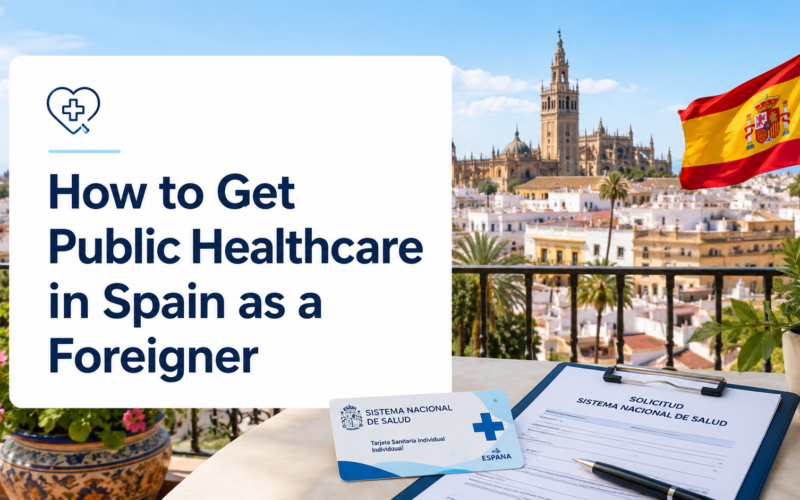
Spain’s public healthcare system — the Sistema Nacional de Salud (SNS) — is consistently ranked among the best in the world. Free at the point of use, well-staffed, and genuinely excellent in most cities. But public healthcare in Spain for foreigners is not automatic. Whether you qualify depends entirely on your residency status, visa type, and municipal registration. This guide explains exactly who is entitled, what documents you need, how to get your Spanish health card, and where the public system falls short — so you know when private insurance fills the gap.
Who can access Spain’s public healthcare system?
The SNS operates on residency, not nationality. Paying into Spanish social security — or qualifying through an international agreement — is what grants you access. Your passport colour is largely irrelevant once you’re a legal resident.
EU/EEA residents with NIE and residency
EU and EEA citizens who register as residents in Spain are entitled to full public healthcare. You need a NIE (Número de Identidad de Extranjero) and your empadronamiento — the municipal registration certificate you get from your local town hall. Once you have both, you can register at your nearest Centro de Salud and apply for your health card.
You do not need to be employed or paying social security to qualify as an EU resident. The right comes from your residency registration. But you must be properly registered — not just living in Spain without paperwork.
Non-EU expats with legal residency (TIE)
Non-EU nationals who hold a TIE (Tarjeta de Identidad de Extranjero — the biometric residency card) and are contributing to Spanish social security through employment are entitled to public healthcare. The key condition is social security affiliation. Without it, TIE alone is not enough.
Some non-EU residents qualify through other routes — for example, family reunification with a qualifying resident. Each case depends on your specific visa category and employment status.
Tourists (EHIC only — emergency cover)
Tourists visiting Spain with a valid European Health Insurance Card (EHIC) — or the UK’s equivalent GHIC — can access emergency and necessary medical treatment in Spain’s public hospitals. This is not a route to routine care. Once your stay ends, so does the entitlement.
If you are not an EU resident and not in Spain on a residency basis, travel insurance or private health coverage is essential for anything beyond emergencies.
Non-lucrative visa holders — NOT automatically entitled
This is the most important distinction many expats miss. If you hold a Non-Lucrative Visa (NLV), you are not automatically entitled to Spain’s public healthcare. NLV holders are not employed in Spain and do not pay into Spanish social security. The public system does not cover them as a result.
This is precisely why the NLV requires private health insurance as a condition of the visa itself. The Spanish government is not assuming responsibility for your healthcare — you are. If you’re on an NLV and relying on the public system without entitlement, you’re taking a significant legal and financial risk.
⚠️ NLV holders — you are not automatically covered
- A Non-Lucrative Visa does not grant access to Spain’s public healthcare system.
- NLV holders are not paying into Spanish social security — the public system excludes them.
- This is why private health insurance is a legal requirement for NLV approval.
- Some NLV holders mistakenly assume residency equals public healthcare access. It does not.
Not Sure You Qualify for the Public System?
Private health insurance covers you from day one — no NIE, no waiting period, no registration queue. Plans for Spain expats start from €40/month.
How to get your Spanish health card (SIP or CIPA)
Spain’s health card goes by different names depending on the region. In Andalucía (Málaga, Seville, Granada) it’s the Tarjeta CIPA. In Valencia, Murcia, and the Balearics it’s the Tarjeta SIP. In Madrid and Catalonia, the naming differs again — but the process and function are identical across all regions.
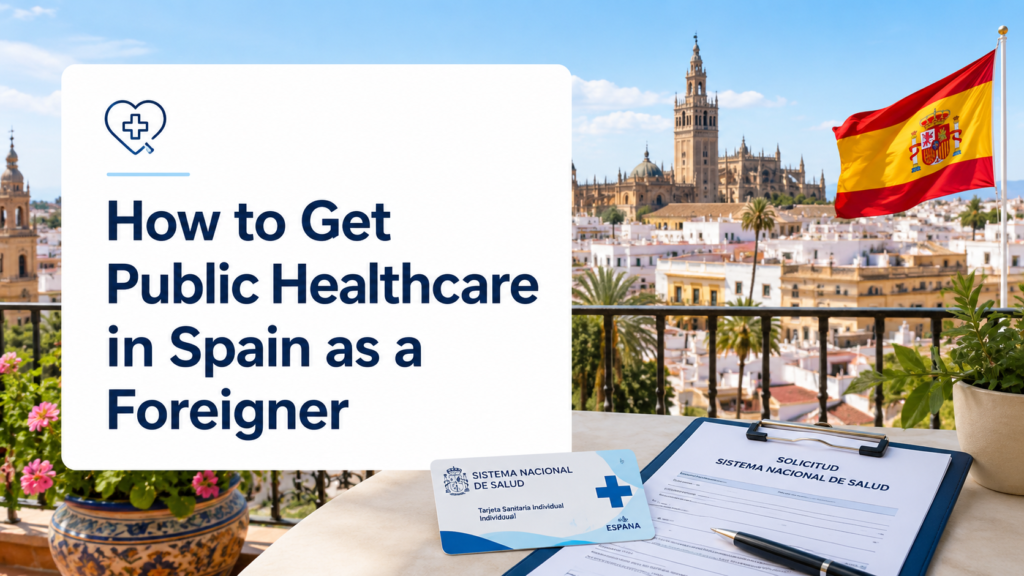
The card is your key to the public system. You present it at every appointment, consultation, and pharmacy visit.
Documents you need for your health card
📋 Documents required — Spanish health card application
- NIE / TIEYour foreign identity number (NIE) or biometric residency card (TIE) — both sides.
- EmpadronamientoMunicipal registration certificate from your town hall. Must be recent — most centres accept within 3 months.
- PassportValid passport, original and photocopy of the photo page.
- Proof of addressSome regions ask for a utility bill or rental contract matching your registered address.
- Social security numberIf applicable — employees and self-employed residents will have this. EU retirees using an S1 form should bring it instead.
Requirements vary slightly between autonomous communities. Andalucía is generally one of the more straightforward regions. Madrid sometimes requests additional documentation at the first visit.
Where to apply (Centro de Salud)
You apply at your Centro de Salud — the local health centre assigned to your registered address. Spain assigns you a health centre based on your empadronamiento postcode, not your choice. You can find your assigned centre through your regional health authority’s website.
In some cases — particularly for non-EU residents — you may need to go to your local INSS office (Instituto Nacional de la Seguridad Social) first to confirm your social security affiliation before the health centre can process your registration.
How long does it take?
In most regions, registration is processed the same day. The card itself — the physical plastic — typically arrives within two to four weeks by post. Some centres give you a paper certificate immediately that works as a temporary health card in the meantime.
In Málaga and across Andalucía, the CIPA number is often assigned on the same day. In Madrid, expect longer — sometimes two to three weeks for full activation. Bring patience and photocopies of everything.
🧑💻 Frank’s experience — registering in Málaga
I registered at my local Centro de Salud in Málaga with my NIE, empadronamiento, and passport. The process took about 20 minutes. I received my CIPA number immediately and the physical card arrived by post twelve days later. One tip: go first thing in the morning. Most health centres are significantly quieter before 9am, and some operate on a first-come, first-served basis rather than appointments for administrative registration.
The S1 form: UK and EU pensioners in Spain
What is the S1 form?
The S1 form (previously called E106 or E121) is a certificate that entitles pensioners living in Spain to public healthcare paid for by their home country. If you receive a state pension from an EU country or the UK and move to Spain, your home country covers the cost of your Spanish public healthcare through this mechanism.
This is a significant benefit. It means qualifying pensioners get full access to the SNS without needing to pay Spanish social security. The quality of care is identical to what any Spanish resident receives.
How to apply for S1 in Denmark and the UK
Danish pensioners: Apply through Udbetaling Danmark. You need to be in receipt of the Danish state pension (folkepension). Contact Udbetaling Danmark, confirm you’re moving to Spain, and request the S1 certificate. They process it and send the form to you directly. Once you have it, take it to your nearest INSS office in Spain to activate your entitlement.
UK pensioners: Apply through the NHS Overseas Healthcare Services (previously NHSBSS). You need to be in receipt of UK State Pension. The process is similar — confirm your move, receive the S1, and register it at the INSS in Spain.
Processing times for S1 applications vary — allow four to eight weeks in both countries. Start the application before you move if possible.
Nice to know
If you’re a Danish pensioner moving to Spain, your S1 also covers your dependants living with you — including a non-working spouse. Apply for the S1 as a household, not just individually. Contact Udbetaling Danmark well before your move date to avoid a gap in coverage on arrival.
What Spain’s public healthcare covers
For entitled residents, the SNS covers a wide range of services with no direct cost at the point of use. Prescriptions are subsidised — not free — typically at 40–60% of the cost, depending on your income and residency status.
Standard coverage includes:
- GP consultations and referrals to specialist care
- Hospital treatment — inpatient and day procedures
- Emergency care and ambulance transport
- Maternity care, including prenatal appointments and delivery
- Mental health services (via GP referral)
- Physiotherapy and rehabilitation (via referral)
- Vaccinations and preventive screening programmes
- Subsidised prescription drugs (40–60% patient contribution)
Dental care is largely excluded from the public system. Basic extractions are covered. Routine dental — fillings, cleanings, crowns — is not. This is one of the key gaps that drives expats towards supplemental private insurance.
Spain SNS — key facts
The SNS covers 47+ million people across Spain. It consistently ranks in the global top 10 for healthcare quality. Spain has 3.1 hospital beds per 1,000 people — above the EU average. Prescription costs: pensioners pay 0–10%, working residents pay 40–60% of drug costs.
Limitations of public healthcare for expats in Spain
The SNS is excellent. But it’s not without real constraints that affect expats more than Spanish residents.
Waiting times: Specialist appointments through the public system can take weeks or months, depending on the specialty and region. A dermatology referral in Andalucía might take four to six months. A cardiology appointment in Madrid might take three. For acute conditions, this is a genuine problem.
Language: Outside major cities and tourist areas, English-speaking doctors in the public system are not guaranteed. In rural Andalucía, consultations are conducted in Spanish. If your Spanish is limited, this creates a real communication barrier at critical moments.
Regional variation: Healthcare quality and access differ significantly between autonomous communities. Madrid and the Basque Country tend to have shorter waits and more resources. Andalucía and Murcia can be more stretched, particularly in summer when the population swells with tourists.
Dental exclusions: Routine dental care is simply not covered. For a full dental plan, you need supplemental private insurance or to pay out of pocket — which in Spain is reasonably affordable compared to Northern Europe.
NLV and Golden Visa holders: As covered above, these groups are excluded from the public system. Private insurance is their only option until they change residency status.
Want Full Coverage Without Waiting Lists?
Private health insurance in Spain costs from €40/month and gives you specialist access within 24–48 hours. Our full comparison covers every major plan available to expats.
Do you still need private health insurance?
For most expats in Spain — yes. The public system is a strong safety net, but it has meaningful gaps. Long specialist waits, dental exclusions, and the language barrier are real day-to-day issues. And for NLV holders, private insurance is legally required regardless of personal preference.
Even expats fully entitled to the public system often carry a supplemental private plan. A mid-range private plan costs €40–€120/month and gives you same-week specialist access, English-speaking doctors, and direct billing. For most people, that’s worth the extra cost.
For a deeper look at how public and private care compare in practice — including which situations each system handles better — read our private vs public healthcare Spain guide.
If you’re still deciding between plans, the most practical starting point is our full comparison. It covers SafetyWing, Cigna Global, AXA Spain, and Sanitas side by side — with honest pricing and visa acceptance details for each. For help planning your first year in Spain’s southern coast, our Marbella expat living guide also covers what to expect from healthcare in that specific area.
Compare the Best Private Health Insurance for Spain Expats
SafetyWing from €40/month. Cigna Global from €130/month. Full side-by-side comparison with visa requirements and honest pricing — all in one place.
Public healthcare in Spain FAQ
Can I access public healthcare in Spain without a NIE?
No. The NIE (or TIE for non-EU nationals) is a prerequisite for registering with the public health system. Without it, you can’t complete your empadronamiento, and without that, the Centro de Salud cannot process your health card application. Your first step when arriving in Spain should always be obtaining your NIE — everything else follows from it.
How long after arriving in Spain can I access public healthcare?
Once you have your NIE and empadronamiento, registration at the Centro de Salud is usually same-day or within one to two weeks. But obtaining the NIE and completing empadronamiento can take four to eight weeks depending on your location and appointment availability. Plan for a gap period — this is why private health insurance from arrival is strongly recommended for most expats.
Is public healthcare in Spain completely free for foreigners?
For entitled residents, consultations and hospital treatment are free at the point of use. Prescriptions are subsidised — you pay 40–60% of the drug cost, depending on your income band and residency status. Pensioners pay significantly less, often 0–10%. Dental care and routine optometry are mostly excluded and must be paid privately.
Does the EHIC cover me for public healthcare in Spain as a foreigner?
The EHIC (or UK GHIC) covers EU and UK citizens for emergency and necessary medical treatment during temporary stays in Spain. It does not grant access to routine care, planned specialist appointments, or any treatment that can safely wait until you return home. It is a safety net for tourists — not a substitute for health insurance or residency-based entitlement for public healthcare in Spain for foreigners living there long-term.
Can a Non-Lucrative Visa holder access Spain’s public healthcare system?
Not automatically. NLV holders are not paying into Spanish social security, which is the primary route to public healthcare entitlement. Some NLV holders retain access through EU EHIC during their first year, but this is not a reliable long-term solution. The NLV requires private health insurance precisely because the public system does not cover holders. For a full breakdown of public healthcare in Spain for foreigners on different visa types, this guide covers each category in detail above.

Frank Pedersen is the founder of Start Life in Spain, a practical website for people who want to move to Spain or understand expat life more clearly. He writes about the real challenges of starting a new life in Spain, including healthcare, insurance, importing a car, buying property, paperwork, everyday living and the practical decisions expats need to make.
Through Start Life in Spain, Frank helps readers look beyond the dream of moving south and understand what it actually takes to settle successfully in Spain. His goal is to make the process easier, more transparent and less overwhelming for future and current expats.