



Moving to Spain checklist 2026: Step-by-Step Expat Guide
Moving to Spain sounds simple until you start dealing with the paperwork. You think you need a place to live, a bank account and maybe some health insurance. Then someone asks for a NIE number. The bank asks for proof of address. The landlord wants payslips. The town hall wants documents you did not know existed. Then you realise Spain is not difficult exactly, but it is very document-driven.
I went through all of it myself. My NIE was done through a gestoría at a notary office in Fuengirola more than ten years ago. My wife got hers the same day. The forms changed, the appointment system moved online, and the Digital Nomad Visa did not exist then. But the basic lesson has stayed the same across all of it: do things in the right order.
This moving to Spain checklist covers the real steps. Not a romantic version about sunshine and wine. Documents, money, healthcare, residency, tax, driving and the small things that make a significant difference once you are actually here.
Last updated: June 2026. Spanish bureaucracy changes regularly. Visa rules, fees, and procedures should always be verified through official Spanish government sources and, where necessary, a qualified gestor or immigration lawyer.
Who this moving to Spain checklist is for
- EU citizens planning to stay in Spain for more than 3 months
- Non-EU citizens applying for a visa before moving
- Remote workers, freelancers and digital nomads
- Retirees and passive-income applicants
- Property buyers on the Costa del Sol
- Families moving with children
- Anyone who wants the practical order of steps, not just a romantic Spain overview
Moving to Spain checklist – quick overview
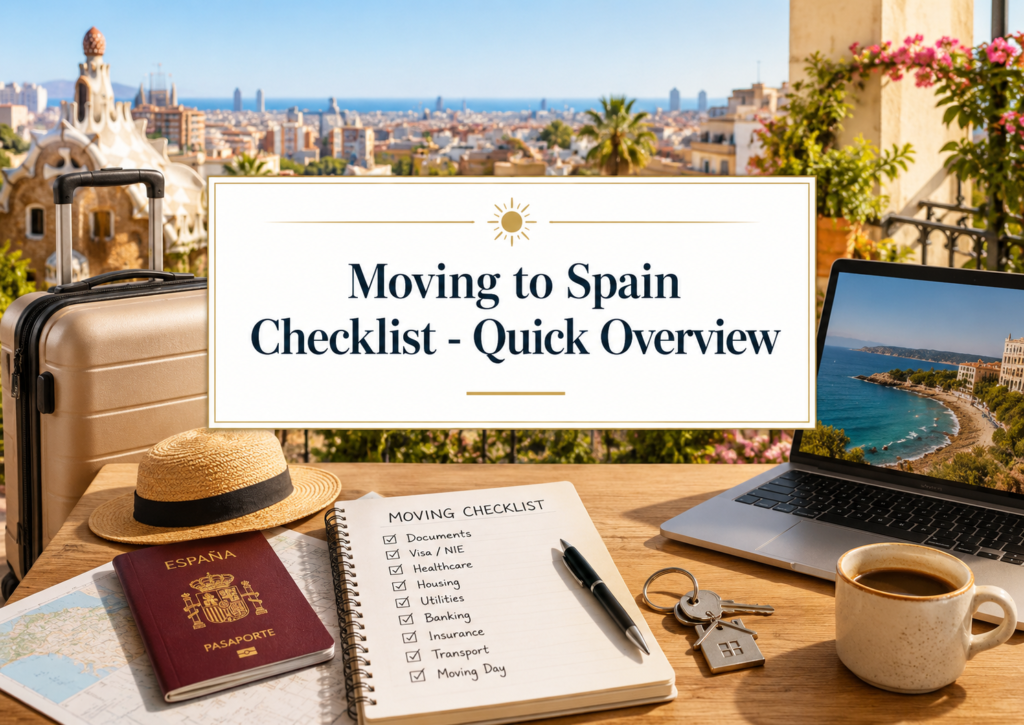
Moving to Spain sounds romantic, and it is, but the practical side can quickly become a mess if you arrive without a plan. NIE number, bank account, health insurance, rental contract, tax questions, school, car, phone, internet — it all comes at once. This quick checklist is the simple overview I wish I had before starting. Not a boring government-style guide, but a real-life starting point for expats who want to land properly, avoid the obvious mistakes, and get settled in Spain with less stress.
| # | What to do | When | Priority |
|---|---|---|---|
| 1 | Decide if you are moving short-term or becoming resident | Before everything | Critical |
| 2 | Check your visa or residency route | 3-6 months before | Critical |
| 3 | Prepare passport, documents and translations | 2-3 months before | Critical |
| 4 | Arrange health insurance or healthcare cover | Before visa application | Critical |
| 5 | Apply for a NIE number | Before or shortly after arrival | Critical |
| 6 | Open a Spanish bank account or non-resident account | Before signing contracts | High |
| 7 | Find temporary housing first – rent before buying | First month | High |
| 8 | Register on the padrón at your local town hall | After you have an address | High |
| 9 | Apply for EU residence certificate or TIE if required | Within the relevant deadline | High |
| 10 | Understand Spanish tax residency | Before staying long-term | Critical |
| 11 | Register as autónomo if you are self-employed | Before invoicing from Spain | Situation-dependent |
| 12 | Sort driving licence, car and Spanish insurance | After deciding on residency | Medium |
| 13 | Set up phone, internet, electricity and utilities | First month | Medium |
| 14 | Handle schools early if moving with children | 3-6 months before | Family-dependent |
| 15 | Choose your first area based on real life, not Instagram | Before committing long-term | High |
| 16 | Build a realistic monthly budget | Before the move | High |
| 17 | Use professionals where the risk is high | Throughout | Situation-dependent |
Frank’s rules for moving to Spain

✅ Frank’s rules – what I tell people before they move
- Do things in the right order. The moving to Spain checklist below is not random. Each step often depends on the one before it.
- Get your NIE before you need it urgently. The appointment delay is usually the problem, not the appointment itself.
- Rent first, buy later. Spain changes street by street. One part of town can be perfect in March and exhausting by August.
- Understand your tax position before you arrive. The 183-day rule is the starting point. It is not the whole picture.
- Bring copies of everything. Spanish offices ask for photocopies of documents you did not know you needed to copy.
- Use professionals where money or legal status is involved. Property, tax, visas and autónomo setup are not the places to save the gestor fee.
- Spain rewards patience. Bureaucracy can be slow. Being angry about it does not make it faster. Having everything ready does.
The order that avoids most problems
- Decide your move type and tax risk.
- Confirm your visa or residency route.
- Prepare documents, apostilles and translations.
- Arrange compliant healthcare cover.
- Get your NIE or book the process.
- Arrange banking access.
- Rent first and register your address on the padrón.
- Complete residency, tax and work registration if required.
Step 1 – Decide what kind of move this really is
The first mistake people make is moving to Spain emotionally before they have moved legally. There is a real difference between spending winters in Spain and becoming Spanish tax resident. Between buying a holiday property and making Spain your main home. Between working remotely from a Spanish apartment for a few months and registering as autónomo.
The paperwork changes completely depending on which of these actually describes you. Before anything else, write down the honest version of your plan.
🌴 Short-stay visitor
NIE needed
Sometimes
Tax residency
Usually no
Registration
Not required
If you are staying less than 90 days and not working, the paperwork is minimal. You will still need a NIE for property or car purchases. Tax residency is unlikely unless you return very frequently across the year.
🏠 Becoming resident
NIE needed
Yes – early
Tax residency
Likely
Registration
Padrón + residency
The full moving to Spain checklist applies. NIE, padrón, residence certificate or TIE, healthcare, banking, tax position – all of it needs to happen in the right order. This is what most of this guide covers.
💻 Remote worker
Visa option
Digital Nomad
Tax risk
High
Autónomo
Often needed
Remote workers face the most misunderstood tax and legal situation. If you live and invoice from Spain, Spanish rules can apply regardless of where your clients are. Take specific advice before you start invoicing from a Spanish address.
🏖 Retiree / passive income
Main visa
Non-Lucrative
Health insurance
Required
Income proof
Required
For retirees and people with passive income, the Non-Lucrative Visa is usually the starting point. It requires sufficient funds and private health insurance. You cannot work in Spain on this visa. Tax implications on foreign pensions and income need early advice.
Step 2 – Check your visa or residency route
Your nationality determines which path you take, and the paths are very different. EU citizens have fewer barriers but still have required steps. Non-EU citizens usually need a visa before they can legally live in Spain long-term.
| Route | Who it is for | Key requirement | Notes |
|---|---|---|---|
| EU residence registration | EU, EEA and Swiss citizens staying 3+ months | Work, self-employment, sufficient funds, or student status | Green certificate or Certificado de Registro. Not the same as a TIE. |
| Non-Lucrative Visa | Non-EU nationals retiring or living on passive income | Sufficient income, no working in Spain, private health insurance | Applied for at Spanish consulate in your country. Cannot work. |
| Digital Nomad Visa | Non-EU remote workers and freelancers | Income from outside Spain, minimum income threshold | Introduced 2023. Allows remote work mainly for non-Spanish clients or employers, subject to current visa rules. Check current requirements carefully. |
| Work Visa | Non-EU nationals with a Spanish job offer | Employment contract with a Spanish company | Employer typically sponsors the process. |
| Student Visa | Non-EU students at Spanish institutions | University or course acceptance, funds, insurance | Does not allow full-time work. Check restrictions. |
| Family reunification | Non-EU family members of Spanish nationals or legal residents | Proof of relationship, sponsor’s residency status | Route varies depending on whether sponsor is Spanish or foreign national. |
⚠️ Visa thresholds change
Income thresholds for the Non-Lucrative Visa and Digital Nomad Visa are linked to Spanish reference amounts such as IPREM, SMI or other official thresholds and can change. Treat any specific number you see online as a planning estimate until you verify the current requirement with the Spanish consulate or a qualified immigration professional.
⚠️ Do not choose a visa based on a Facebook group
Visa rules are technical and consulate-specific. What worked for someone in a different country, applying two years ago, in a different personal situation, may not work for you. Use official Spanish government sources and a qualified immigration professional for visa applications. A rejected visa application or a wrong visa type can delay your move by months.
EU vs non-EU moving to Spain checklist
| Step | EU/EEA/Swiss citizen | Non-EU citizen |
|---|---|---|
| Before arrival | No visa needed – prepare proof of income, healthcare and identity documents | Usually apply for visa at Spanish consulate before moving |
| NIE number | Needed for all formal transactions in Spain | Often assigned during visa/residency process or applied for separately |
| After 3 months | Register as EU resident if staying longer than 3 months | Apply for TIE if visa or residence authorisation requires it – often within 1 month of entry |
| Healthcare | Depends on work, S1, EHIC/GHIC or private cover | Usually private insurance required unless working and contributing to Social Security |
| Work | Allowed, but autónomo registration and Spanish tax rules may apply | Only if visa or residence authorisation explicitly permits it |
| Tax residency risk | 183-day rule applies equally regardless of EU status | 183-day rule applies – and visa type does not protect from tax residency |
Step 3 – Prepare your documents before you leave
Spanish bureaucracy is much easier when you arrive with the right papers. Most people underestimate this step. They arrive with one copy of a passport and a marriage certificate from 1998 that has never been officially translated, then spend their first month chasing documents from home.
📋 Documents to prepare before moving to Spain
- Passport – valid for the full duration of your intended stay, plus buffer. Renew before applying for anything
- National ID card – if applicable for your country
- Birth certificate – may need apostille and Spanish translation for official procedures
- Marriage certificate – if relevant for residency, tax or joint applications
- Divorce documents – if applicable
- Criminal record certificate – required for many visa applications. Must be recent
- Proof of income – bank statements, pension letters, employment contracts or business accounts
- Private health insurance certificate – for visa and residency applications where required
- Remote work contract or company documents – for digital nomad or autónomo procedures
- School records for children – for enrolment in Spanish schools
- Driving licence – original plus copies
- Property documents – if buying, the arras (deposit contract) is the key early document
What apostille, translation and recent issue mean in practice
ApostilleOfficial government stamp certifying a document is authentic for use abroad
Official Spanish translationMust be done by a sworn translator – not Google Translate or a bilingual friend
“Recent issue” requirementMany documents must be issued within the last 3 or 6 months – check for each application
Safe approachPrepare 2 certified copies of every document and store digital backups before leaving home
Documents by move type
| Move type | Documents to prepare early | Why |
|---|---|---|
| EU resident | Passport or ID card, proof of funds or employment, healthcare proof, NIE if already issued | Needed for EU residence registration and all local administration |
| Non-Lucrative Visa | Passport, criminal record certificate, medical certificate, income proof, private health insurance | Visa applications fail when documents are old, untranslated or incomplete |
| Digital Nomad Visa | Remote work contract or company letters, income proof, Social Security or tax documents | Must prove remote work structure and meet income threshold clearly |
| Property buyer | Passport, NIE, proof of funds, arras contract, mortgage documents if applicable | Notaries and banks need clean documentation before completion. NIE is non-negotiable. |
| Family with children | Birth certificates, school records, vaccination records, custody documents if relevant | Schools and residency applications often require translated and apostilled documents |
| Autónomo / self-employed | NIE, passport, proof of activity, accountant confirmation, bank account details | Hacienda and Social Security registration requires NIE and evidence of activity |
Step 4 – Healthcare
Healthcare is one of the first things to sort and one of the most commonly mishandled. Spain has a strong public healthcare system but not every foreigner gets automatic access from day one. Public healthcare access depends on legal residence status, Social Security entitlement, EU coordination rules, family entitlement or specific regional rules. Do not assume that having a NIE or padrón automatically gives you access.
✅ When you may access public healthcare
- Working in Spain and paying into the Spanish Social Security system
- Registered as autónomo and paying monthly Social Security contributions
- EU pensioner with a valid S1 form from your home country
- EU visitor using an EHIC/GHIC card for necessary treatment during temporary stays
- Family member of someone entitled to Spanish public healthcare
🔴 When you need private health insurance
- Applying for a Non-Lucrative Visa – private health insurance is a condition of the visa
- Digital Nomad Visa – adequate health coverage is required
- Resident with no Spanish work or Social Security contributions
- Non-EU nationals without entitlement through employment or family
- Anyone who wants faster, English-speaking specialist access from day one
A common mistake is buying travel insurance and assuming it covers Spanish residency requirements. It does not. Before you buy private health insurance, check whether it is accepted for visa purposes, covers hospitalisation, has no exclusions on pre-existing conditions, and provides a certificate in Spanish. Our guide to Cigna Global Spain covers one of the most popular options for expats with residency requirements in mind.
Step 5 – Apply for your NIE number
The NIE number in Spain is the foreigner identification and tax number you will need for most serious paperwork. Property purchase, autónomo registration, opening normal Spanish banking relationships, signing contracts at a notary, filing taxes, buying a car – all of them usually require a NIE.
NIE number Spain – what to know
What it isForeigner identification and tax number
FormatX-1234567-A
Is it residencyNo – it is a number, not a residence status
Official formEX-15 + Modelo 790 Código 012
Appointment wait (peak)4-6 weeks in Málaga province
Gestoría routeAround €60-150 total – often much faster
I used a gestoría in Fuengirola because I needed the number quickly for a property process. It cost more than the DIY route but took about a week from start to finish. For property purchases on the Costa del Sol, the notary’s own gestoría often handles NIE applications as part of the transaction – worth asking before booking a police appointment yourself.
For the full process including EX-15, Modelo 790, justification documents and Costa del Sol office locations, read our complete NIE number Spain guide.
Step 6 – Open a Spanish bank account
You do not need a Spanish bank account on day one, but life becomes noticeably easier once you have one. Rent payments, utility bills, community fees, local tax and insurance payments all work more smoothly through a Spanish account. Some landlords will not accept a foreign IBAN for a standing order.
✅ Before choosing a Spanish bank
- Monthly fees – many accounts charge €5-15 per month. Some are fee-free under certain conditions
- Whether they require a NIE – most traditional banks do. Non-resident accounts may be possible with passport only at some banks
- English-speaking support – varies significantly even within the same bank depending on branch
- Mortgage availability – if buying property, check the bank’s non-resident mortgage terms before opening an account
- Whether they handle autónomo and tax payments – important if you are self-employed
- While you wait for a NIE – Wise and Revolut both operate without a Spanish NIE and give you a euro IBAN to receive money immediately
For a full comparison of traditional Spanish banks and fintech alternatives, including which accounts work best for non-residents before a NIE is issued, read our guide to the best bank accounts for expats in Spain. If you are applying as a non-resident specifically, our guide to opening a bank account as a non-resident covers the process step by step.
Step 7 – Rent before you buy
Unless you know the area extremely well, rent first. This is the single most consistent piece of advice I give to people moving to the Costa del Sol and it is the one most often ignored because people fall in love with a place on a sunny two-week visit in May.
Spain changes by season, by street, and by hour. A beautiful apartment can be noisy from midnight to 3am every weekend between June and September. A quiet urbanisation outside town can feel isolated once the summer visitors leave. A sea-view property can have no parking, terrible wifi infrastructure and no supermarket within walking distance.
✅ What to check before signing a long-term rental contract
- Noise – visit the property on a Friday night and a Sunday afternoon, not just a Tuesday morning
- Parking – especially in older coastal towns where spaces are few and garages are expensive
- Internet – check fibre availability for the specific address before signing anything. Listings are frequently wrong
- Humidity and orientation – north-facing properties on the coast can be damp in winter. Ask when the sun reaches the terrace
- Air conditioning – summer electricity bills in older properties without good insulation can be shocking
- Community fees – in developments with pools and gardens, these can add €100-300 per month
- Winter atmosphere – many coastal towns are deserted October through February. Check if that suits you
- Distance to healthcare – especially important for older residents or families
Step 8 – Register on the padrón
The padrón, also called empadronamiento, is your registration at the local town hall. It records that you live at a specific address in Spain. It is not the same as residency. It is proof of address within a specific municipality.
You may need the padrón certificate for residency procedures, healthcare registration, school enrolment, some vehicle registration processes, local tax calculations and accessing certain municipal services. Registration is done at the ayuntamiento – the town hall – for the municipality where you live.
📋 What you typically need for padrón registration
- Passport or national ID card (original and copies)
- NIE or residence document, if you have one
- Signed rental contract or property deed as proof of address
- Recent utility bill, if requested by the municipality
- Authorisation from the property owner if you are renting and your name is not on the contract
- Completed registration form from the town hall – often available at the office
⚠️ Padrón rules vary between municipalities
One municipality may ask for documents another one does not. Some require an appointment booked online. Some still handle it as a walk-in. Do not assume Fuengirola works like Marbella, or that Marbella works like Málaga city. Check your specific ayuntamiento’s requirements before you go.
Step 9 – Complete your residency paperwork
A NIE does not make you resident. The padrón does not make you resident. Residency is a separate legal status with its own registration, forms and deadlines. Many people skip or delay this step and find themselves in a complicated position later.
| Residency type | Who | Document received | Key evidence needed |
|---|---|---|---|
| EU Residence Certificate | EU, EEA, Swiss citizens staying 3+ months | Green paper certificate including NIE number | Work/self-employment, sufficient funds or student status. Plus healthcare. |
| TIE card (non-EU) | Non-EU nationals with a visa or authorisation | Physical identity card showing NIE and residence status | Visa, fingerprints, photos, forms, fee. Collected separately after processing. |
| Permanent residency | After 5 years of continuous legal residence | Updated certificate or card showing permanent status | Evidence of continued legal residence over the 5-year period |
For non-EU citizens, arriving in Spain with a visa sticker is not the final step. For many non-EU long-stay visa holders, the TIE card must be applied for after arrival – often within one month of entry. Check the exact deadline and procedure for your specific visa type before travelling, as requirements differ. Use a gestoría or immigration lawyer if you are unsure about timing.
Step 10 – Understand Spanish tax residency before it surprises you
This is the step most people deal with too late. Spanish tax residency is not a feeling or an intention – it depends on facts, time and economic ties. Getting this wrong is one of the most expensive mistakes you can make in the Spain move process.
⚠️ Spanish tax residency – what triggers it
- The 183-day rule – spending more than 183 days in Spain during a calendar year is the most widely known trigger, but it is not the only one
- Centre of economic interests – if your main income, business or investments are managed from Spain, this can trigger tax residency regardless of days spent
- Family base – if your spouse and children live in Spain, Spain may presume you are resident even if you spend significant time elsewhere
- Property ownership – owning property in Spain and spending long periods here can contribute to residency arguments
The consequences of unexpected tax residency include having to declare your worldwide income in Spain, Spanish income tax on foreign pensions or dividends, reporting requirements for foreign bank accounts and assets over €50,000 (Modelo 720), and potential wealth tax exposure depending on your situation.
Remote workers, business owners with foreign clients, pensioners with pension income abroad and investors with overseas portfolios are all in situations where early tax advice is not optional. A one-hour consultation with a qualified Spanish tax adviser before the move is significantly cheaper than resolving a tax residency problem after the fact.
Step 11 – Register as autónomo if you are self-employed
If you are self-employed and working from Spain – freelancer, consultant, digital business owner, contractor, coach or creator – you may need to register as autónomo in Spain. The common belief that because your clients are outside Spain the rules do not apply to you is frequently wrong. If you live in Spain and invoice from Spain, Spanish rules can apply.
Autónomo in Spain – what it involves
Social Security (monthly)Income-based contribution – verify current cuota and any reduced-rate options before registering
IVA (VAT) returnsQuarterly – typically Modelo 303
IRPF (income tax) paymentsQuarterly advance payments – Modelo 130
Annual declarationIRPF return (Renta) filed in April-June of following year
Good accounting softwareStrongly recommended – Holded, Quaderno and others handle Spanish compliance
For the full registration process including Hacienda, Social Security, the current tarifa plana for new registrants, and the forms involved, read our complete guide to registering as autónomo in Spain. For managing the quarterly filings and accounting, our guide to the best accounting software for autónomos covers what actually works in practice.
Step 12 – Driving licence and car
Driving in Spain is straightforward. The admin around licences and vehicle registration is less so and often left too late.
🚗 Driving and vehicles – key things to check
- EU licence holders – valid in Spain while in date, but once you become resident your licence must eventually be exchanged for a Spanish one when it expires. Rules on timing and process can vary
- UK licence holders – post-Brexit, UK licences are subject to a bilateral exchange agreement. The rules have changed. Verify the current process at the DGT before assuming your UK licence is indefinitely valid in Spain as a resident
- US, Canadian, Australian licences – exchange rules depend on your country. Some countries have agreements with Spain. Others require tests. Check the DGT website for current bilateral agreements
- Bringing a car to Spain – once you become resident, you typically have 30-60 days to register the vehicle with Spanish plates. The costs can be significant: import fees, ITV inspection, conformity documents and registration tax
- Buying in Spain – often simpler than importing. A used car bought in Spain already has Spanish plates and documentation
- Car insurance – Spanish insurance is required from day one of driving in Spain. An international insurance certificate from your home country may cover temporary stays but may not be valid for resident driving
Step 13 – Utilities, phone and internet
The practical setup of daily life is not bureaucratically complex but can be logistically annoying if you leave everything to the last minute. A Spanish mobile number is the first thing to get – banks, deliveries, appointment systems and two-factor authentication all rely on it.
📱 Practical setup checklist
- Spanish SIM card – get one within the first week. Pay-as-you-go SIMs are available at phone shops and supermarkets without a NIE. A contract SIM typically requires a NIE and bank account
- Home internet – check fibre availability for the specific address of any property you are signing a contract on. Movistar, Orange and Vodafone have the widest coverage. Do not assume the rental listing is accurate
- Electricity contract – in Spain you can choose your electricity provider from the liberalised market. Endesa, Naturgy and Repsol are among the largest. Compare tariffs before signing
- Water – usually provided by the municipality. Set up direct debit once you have a Spanish bank account
- Home insurance – required by most mortgage agreements and recommended for rentals. Covers contents, liability and often includes legal protection
- Electricity costs – air conditioning in summer can be expensive in older properties, especially those with poor insulation and east-west facing aspects. Factor this into your budget before signing a rental in summer
Step 14 – Schools if moving with children
If you are moving with children, school planning needs to happen in the first stage of the move process, not after you have signed a rental contract. Public school places in Spain depend on your registered address. International school waiting lists can stretch 12-18 months in popular expat areas.
✅ School options in Spain
- Spanish public school – free, language of instruction is Spanish. Good language immersion for children under 10. Place allocation depends on your padrón address and available spaces in the zone
- Concertado school – partially state-funded private school. Usually lower cost than full private. Often Catholic. Place allocation varies
- Private Spanish school – fully private, Spanish language focus. Higher fees. No catchment restriction
- International school – English, German, French or other language instruction. High fees (€8,000-20,000+ per year in most Costa del Sol schools). Waiting lists at popular schools. Check availability before choosing where to live
- Bilingual schools – public and private schools with bilingual Spanish-English programmes. Growing in availability but not uniform across municipalities
For families, the right area to live is often the area where the school you actually get into fits with your commute, budget and lifestyle. Choose the school first, then the neighbourhood – not the other way around.
Step 15 – Choosing your area on the Costa del Sol
Spain is not one lifestyle. Central Málaga is completely different from a villa outside Mijas, an apartment in Fuengirola, or a luxury development in Marbella. The Costa del Sol alone has enough variation to suit very different kinds of expat life – and enough variation to deeply disappoint if you chose on the basis of a holiday visit in June.
| Area | Best for | Character | Less ideal for |
|---|---|---|---|
| Málaga city | City life, culture, airport access, younger expat community | Fast-growing, international, strong restaurant and nightlife scene | Cheap rentals or quiet beach life |
| Benalmádena | Families, year-round residents, good transport links | Mixed residential and tourist. Good practical base. | Those wanting a purely local Spanish feel |
| Fuengirola | Beach life, international community, good transport | Large expat population, active high street, strong British community | Those who want to avoid the tourist atmosphere |
| Mijas | Space, views, quieter lifestyle, lower density | Mix of Mijas Pueblo (traditional) and Mijas Costa (coastal developments) | People without a car or who want walking-distance amenities |
| Marbella | Luxury lifestyle, international schools, business networking | Expensive, international, good infrastructure. Busy in summer. | Tight budgets or quiet village life |
| Estepona | Newer developments, families, slower pace | Cleaner, less touristy than Marbella. Growing infrastructure. | Those wanting immediate city amenities |
| Nerja | Smaller-town atmosphere, dramatic scenery | Quieter, Andalusian feel, popular with Northern Europeans | Airport access, city services, large expat community density |
My honest view after more than ten years near Fuengirola: do not choose purely from photos or from a holiday visit. Spend at least one full week there in November or February, when the summer crowds have gone and the winter reality of the area is visible. The Costa del Sol is one of the best places in Europe to live. It is also one of the easiest places to choose the wrong town if you only visited in good weather.
Step 16 – Build a realistic monthly budget
Spain can be cheaper than Northern Europe. But the cheap-Spain story is often exaggerated, particularly on the Costa del Sol. Marbella is expensive by any Western European standard. Málaga has become significantly more expensive in the last five years. Even Fuengirola and Benalmádena have seen rental prices increase sharply since 2021.
Monthly budget items to plan for in Spain
Rent (2-bed apartment, Fuengirola / Benalmádena)€900-1,400/month
Electricity (summer with AC)€150-350/month – older properties can be higher
Private health insurance (one adult)€60-150/month depending on age and cover
Autónomo Social SecurityIncome-based contribution – verify current cuota and reduced-rate options before registering
Gestor / accountant€50-150/month for autónomo compliance
Community fees€80-300/month in most Costa del Sol developments
Car insurance + fuel + IBI (property tax)Varies widely – factor these in before signing a rental
A retired couple, a single digital nomad, a family with two children in international school and a business owner who is autónomo have completely different budget realities in Spain. Build your specific numbers before you commit to a monthly spend you cannot sustain once you stop being a tourist and start being a resident.
Step 17 – When to use professionals
You do not need a lawyer for everything and you do not need a gestor for every form. But there are specific situations where professional help is worth considerably more than it costs.
✅ Use a professional for these
- Property purchase – always use an independent lawyer, not just the agent’s recommended contact
- Visa applications – the cost of rejection is higher than the fee
- Tax residency planning – especially if you have income, investments or business interests outside Spain
- Autónomo registration – coordinate NIE, Hacienda and Social Security together
- Car importation – the costs and paperwork are more complex than most people expect
- Inheritance or estate planning – Spanish inheritance law is different from UK/US/EU equivalents
📋 How to choose a professional
- Do they speak your language fluently? Not just conversational English
- Do they state fees clearly in writing before you engage?
- Do they respond to emails promptly? This is a reliable quality signal
- Do they know your specific municipality? Local knowledge matters in Spain
- Are they qualified for the service they are providing? Gestor, lawyer and accountant are different roles
- Did you find them through a referral from someone whose situation is similar to yours?
What not to do in your first month in Spain
⚠️ Avoid these first-month mistakes
- Do not buy property before you understand the area in both winter and summer
- Do not register as autónomo before speaking to an accountant if your income is international
- Do not assume your home-country driving licence works indefinitely once you are resident
- Do not sign a rental contract without checking internet speed, noise, humidity, parking and the owner’s details
- Do not use travel insurance for a visa or residency route that requires compliant health insurance – they are different products
- Do not rely on Facebook groups for visa, tax or legal decisions – use them for local recommendations, not legal guidance
- Do not leave padrón registration until you think you need it – do it as soon as you have a stable address
Common mistakes when moving to Spain
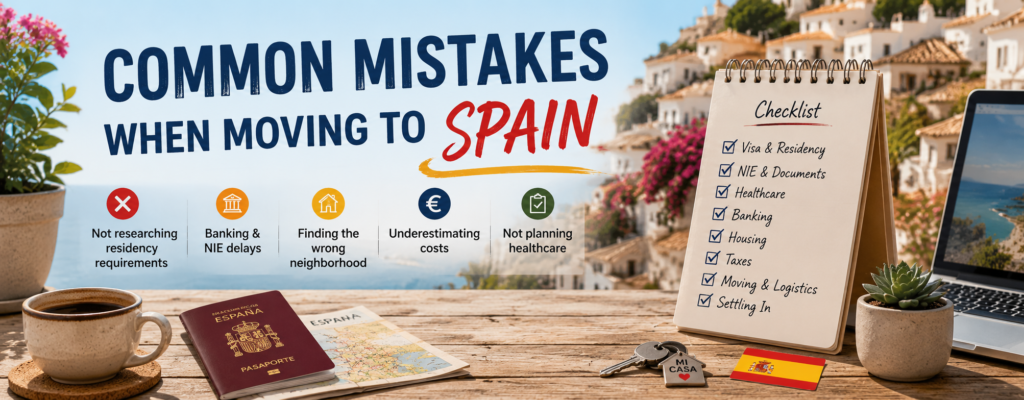
⚠️ The mistakes that cost expats the most time and money
- Thinking the NIE is residency. It is not. A NIE number in Spain is an identification number. Residency is a separate legal status.
- Staying too long without checking your tax position. The 183-day rule is the starting point, not the complete picture. Get advice before the move, not after your first Spanish tax return is overdue.
- Buying property before renting in the area. Rent first unless you know the specific street, neighbourhood and municipality well enough to commit to a purchase.
- Using travel insurance for residency applications. Many visa and residency routes require compliant health insurance, not basic travel cover. They are different products.
- Ignoring appointments. Most Spanish administrative procedures require a cita previa. No appointment usually means no service. Book early and confirm the day before.
- Assuming every town hall and Extranjería office works the same way. Spain is local. Requirements, processing times and procedures vary between municipalities. What worked for your neighbour in another town may not apply to you.
- Trusting Facebook groups as a primary source. Expat groups are useful for warnings and local recommendations. They are not a substitute for official information or professional advice on legal, tax and visa matters.
- Moving too fast and not getting it in writing. Verbal agreements in Spanish landlord-tenant and service relationships are not reliable. Get everything in writing and keep copies of everything.
Moving to Spain checklist – suggested timeline
Foundation decisions and document preparation
- Decide your move type – short stay, full residency, remote work, retirement
- Identify your visa or residency route and check current requirements
- Speak with a Spanish tax adviser if you have income, business or assets abroad
- Research areas – visit during winter months if possible, not just summer
- Check international school availability if moving with children
- Collect and apostille documents you will need for visa or residency
- Renew passport if it expires within 12 months
- Start researching private health insurance options
Applications, bookings and financial setup
- Apply for visa if required – allow time for consulate processing
- Book NIE appointment or engage a gestoría to handle it
- Compare bank accounts and open a non-resident account or Wise/Revolut for immediate euro access
- Arrange private health insurance and confirm it is valid for your intended residency route
- Book temporary accommodation – do not commit to a long-term rental before seeing it in person
- Check driving licence exchange rules for your country
- Prepare document copies in physical and digital form
Arrival essentials
- Get a Spanish SIM card – you need a phone number for almost everything
- Attend NIE appointment if already booked
- Start long-term rental search – view in person, check wifi, noise and parking
- Keep receipts and copies of every document you sign
- Identify a local gestor or accountant if needed – get recommendations from people you trust
- Do not sign anything with unfamiliar Spanish legal clauses without checking first
Address registration and daily life setup
- Secure your long-term address and sign the rental contract
- Register on the padrón at your local ayuntamiento
- Open a full Spanish bank account once you have a NIE and address
- Set up electricity, water and internet contracts in your name
- Arrange home insurance
- Register with a doctor or private healthcare provider
- If autónomo, begin the Hacienda and Social Security registration process
Residency, tax and long-term decisions
- Complete EU residence registration or begin TIE application if applicable
- Review your tax residency position – are you now Spanish tax resident?
- Register as autónomo if you are working or invoicing from Spain
- Sort driving licence exchange if needed for your nationality
- Register vehicle with Spanish plates if you brought a car from abroad
- Build local contacts – other expats, professionals, neighbours
- Review your actual monthly budget against what you planned
Official Spain moving resources

📚 Official links to check before moving
- Spanish Ministry of Foreign Affairs – visa and consular information by country
- Policía Nacional foreigner procedures – NIE, TIE and residence documents
- Cita Previa Extranjería – appointment system for immigration procedures
- Agencia Tributaria – Spanish tax residency, IRPF and tax filing
- Spanish Social Security (Seg-Social) – autónomo registration and public healthcare entitlement
- DGT – driving licences, vehicle registration and exchange agreements
Moving to Spain checklist – frequently asked questions
What is the first thing I should do before moving to Spain?
Decide whether you are moving temporarily or becoming resident. That single decision changes your visa requirements, tax position, healthcare setup, banking needs and paperwork sequence. Every step on this moving to Spain checklist depends on the honest answer to that question.
Do I need a NIE number to move to Spain?
You will almost certainly need one if you plan to live, work, buy property, register as self-employed or deal with Spanish tax. You can often start the move process without a NIE but cannot complete most formal steps without one. Apply as early as possible – appointment availability, particularly in Málaga province in summer, can stretch to 4-6 weeks.
Is a NIE the same as Spanish residency?
No. A NIE is a foreigner identification number. It is a number on a piece of paper. Residency is a separate legal status – EU residence certificate or TIE card – that requires a separate application and different evidence. Many people complete one without the other and find themselves in a complicated position later.
Can I move to Spain without a job?
Yes. EU citizens can register as residents with sufficient funds and healthcare cover. Non-EU citizens may qualify for the Non-Lucrative Visa (passive income or savings), the Digital Nomad Visa (remote work), or other routes. What you cannot do as a non-EU citizen on a Non-Lucrative Visa is work in Spain. Take advice before choosing a route if your situation is not straightforward.
When do I become tax resident in Spain?
The best-known trigger is spending more than 183 days in Spain during a calendar year. But your centre of economic interests and family situation can also create tax residency regardless of days spent. If your spouse and children live in Spain, Spain can presume you are resident even if you believe you are not. Get tax advice before you commit to the move, not after your first year is complete.
Should I rent or buy first in Spain?
Rent first unless you know the specific area extremely well – and by that I mean you have spent time there in winter as well as summer, walked the streets at night, checked the parking, tested the internet and spoken to people who actually live there year-round. The Costa del Sol is a very different place in February from what it is in July.
Do I need private health insurance to move to Spain?
Depends on your situation. If you are working and paying into Spanish Social Security, you may access public healthcare. If you are applying for a Non-Lucrative Visa, Digital Nomad Visa or certain residency routes without working, private health insurance that meets Spanish requirements is mandatory, not optional.
Can I work remotely from Spain?
You can physically sit in Spain and do remote work. Whether you are legally entitled to do so and what tax and Social Security obligations that creates is a different question. Non-EU citizens need a visa that permits this. EU citizens have fewer barriers but can still trigger autónomo registration and tax residency obligations. Take specific advice before invoicing from a Spanish address.

Frank Pedersen is the founder of Start Life in Spain, a practical website for people who want to move to Spain or understand expat life more clearly. He writes about the real challenges of starting a new life in Spain, including healthcare, insurance, importing a car, buying property, paperwork, everyday living and the practical decisions expats need to make.
Through Start Life in Spain, Frank helps readers look beyond the dream of moving south and understand what it actually takes to settle successfully in Spain. His goal is to make the process easier, more transparent and less overwhelming for future and current expats.